
In his famous essay published in 1996, Bill Gates said that “Content is King”. In other words, he predicted that content is where a lot of money would be made on the internet.
While this continues to be true today for the most part, the truth is that content has been commoditized to a great extent. With millions of articles published each day, it is nigh impossible to stand out just with great quality content.
Content distribution is where the real money lies.
Content distribution is the process of spreading the word about your b2b content across various marketing channels. This could be your social media handles, company newsletters, search engines, ad spots, or partnerships.
Successful content distribution does not happen by chance. It is not art, but science. Content distribution planning ensures that each of your content investments derives maximum value in terms of traffic and leads.
What exactly is content distribution planning?
Content distribution planning is the process of ideating the right strategy to allocate your distribution budget across various marketing channels. The objective of a content distribution plan is to derive the maximum return on your content investment.
This is a multi-step process that begins with understanding your target group, identifying the right distribution channels, building a distribution plan for each of these channels, executing the distribution plan, and finally tracking content performance.
This is a multi-step process that begins with understanding your target group, identifying the right distribution channels, building a distribution plan for each of these channels, executing the distribution plan, and finally tracking content performance.
Step 1: Identifying the target audience
Each piece of content appeals to a certain kind of audience. Identifying and targeting this audience for your campaign can ensure high reach and success.
This may seem quite straightforward at the outset — after all, you know who you are selling your product or service to. This is information that is already available to you.
In reality, though, this may not always be adequate. The target audience for a piece of content is typically a smaller sub-group within your larger target audience. Depending on your content plan, it is sometimes even likely that the target audience for a specific piece of content is not among any of your business audience.
Knowing who your content speaks to is a critical first step in your content distribution plan. Getting this wrong would mean a lower return on your investment.
The natural question here is, how does one go about picking the right target audience for your marketing collateral?
The most effective way to do this, in my experience, is by writing for a single ideal reader.
Take this article, for example. While Foleon as a business could target the sales and marketing teams across various industries, I am writing this article specifically for content marketing managers. In fact, you could pick one specific profile off LinkedIn that meets this criteria and write your article for them.
This way, every word, phrase, and example used in the article appeals to this cohort of readers, making it more relatable and appealing to this audience.
Step 2: Identifying your channel mix
At this point, you have identified your ideal reader. The next step is to draft a strategy to reach them.
There are broadly three categories of distribution channels:
Owned: Includes all distribution channels you own and control (website, blog, email list, podcast, etc.)
Earned: Includes distribution channels that reward you with traffic and leads without directly paying for them. Google Search, brand citations, social shares, and customer reviews are all part of the earned media mix.
Paid: Includes all distribution channels that you pay to gain access to. PPC ads, paid influencer collaborations, and sponsored posts are all examples of paid distribution channels.
Each of these distribution channels provides you with a certain leverage to build traction for your content.
Owned channels are a reflection of the leverage you have built over time, including through paid channels. A business with a mailing list of 50,000 subscribers is likely to derive better exposure than one that is just starting out.
Earned channels are a reflection of your content quality. Good quality content earns better media mentions and shares compared to poor quality content.
Paid channels demonstrate your financial bandwidth to extract mileage through your article. A higher budget often correlates with higher exposure and returns.
Your channel mix must be based on your existing leverage (followers, subscribers, etc.), content quality, and distribution budget.
Step 3: Finalizing your calendar and content alignment plan
Do you have your content drafted already? Great, but that’s just the first step.
The next step is to format and repurpose this article or blog post to suit the needs of each channel in your mix.
For example, if you plan to use a marketing automation platform like GetResponse or MailChimp to distribute your article, then you have to work on the email copy that goes with the link. The same is true with sharing on Facebook, through an influencer network, or through ads.
When working on your content alignment plan, it is also important to build out your distribution calendar. Knowing the sequence in which your content shall be distributed across these various channels will allow you to build a more robust b2b marketing strategy.
For example, if your Facebook distribution goes before your email blast, then it may be a good idea to share the link to your Facebook post within your email sent using software like MailerLite, to drive further traffic and likes to your social media post.
Step 4: Performance tracking
The last step in content distribution planning is to track the performance of your content distribution strategy. To do this, we may have to first build the baseline content marketing metrics to track.
Key metrics to track
Here are some metrics that a content distribution plan must track.
Leads: Lead tracking is the measurement of how many leads were added to your pipeline as a result of your content marketing efforts. This is by far the most scientific method.
Tracking leads generated as the key metric helps normalize your content marketing report and helps you optimize your lead generation strategy for better performance.
Social likes and page impressions: While lead tracking helps measure the exact revenue impact of your content marketing plan, some businesses prefer to measure the content’s impact on brand awareness or brand perception instead. This is typical in retail or luxury segments, for example.
In such cases, metrics such as page impressions and social likes are ideal, as they tell you how many people viewed your content and engaged with it.
Content attribution
Besides tracking the performance of your campaign, your content distribution plan must also track the source of your traffic. This is done by tracking each lead or pageview down to the source of the click.
But as mentioned previously in this article, your content distribution calendar allows you to cross-promote your various channels to elevate the overall performance of your campaign.
This can, however, lead to an attribution problem since a visitor who clicks through more than one channel could be attributed to these multiple avenues.
As a general rule of thumb, it is a good idea to attribute every lead generated to its last touchpoint.
This means that if an email subscriber reads your newsletter, clicks on the social link to land on the article before signing up for a free trial, then the lead is attributed to the social media link instead of the newsletter.
Performance tracking is a continual optimization process. Understanding the lead conversion rate across different channel mixes helps you reallocate your budget across these different channels for your future campaigns.
Factors that impact your content distribution plan
Some content distribution channels are more effective at generating leads than others. In an ideal world, you could throw all your money into these channels and reap the returns.
But this seldom happens. There are a number of factors that determine the optimal distribution strategy for your demand generation content.
Goals and objectives
Your channel mix depends heavily on your goals and objectives. Is brand awareness what you’re aiming for? In such cases, paid and earned media may need to be prioritized since these are channels that reach a new cohort or audience.
However, if you are running a bottom-of-the-funnel campaign, then owned media is a better choice since this audience already follows you, and your nurturing could nudge them into converting.
Content type
Content type and mix can highly influence your decision on content channels. Textual content (including blogs and ebooks) works well with distribution channels like SEO, mailing lists, and LinkedIn. Video content works well on social media. Also, depending on content access (free content versus gated content), you may need to pick between paid channels and others.
Your content format also plays a critical role when it comes to distribution. HTML-based formats, like Foleon Docs, allow you to update your content even after publication. That means any changes you make to your content piece are reflected live, across all of your distribution channels — no more scrambling to delete out-of-date PDFs or hoping nobody spotted the typo in your e-Book.
Distribution budget
Investing in a paid channel mix is not possible without a sizable content distribution budget. Oftentimes, bootstrapped early-stage startups invest heavily in owned and earned channels because paid channels require budgets that cannot always be justified with returns.
Industry and audience
Some distribution channels work great for certain industries and may be a poor fit for others. B2C businesses (including retail eCommerce) may be a poor fit for LinkedIn, for instance, while an industrial supplies company may prefer more traditional channels like SEO or email newsletter over social media for their content distribution.
Capitalizing on your strengths
What does your current channel mix look like? Do you already own a large mailing list or following on Instagram or LinkedIn? Are you an industry leader with a great search engine presence? Finding ways to capitalize on these strengths can reduce your reliance on paid media.
There could also be other ways to use your resources more efficiently. For instance, you may have an in-house prompt engineering team to help with producing high-quality videos. This tilts the balance in favor of creating video content since your production costs will be much lower. This internal efficiency is part of a broader shift where AI has become the ultimate point of leverage. By integrating these tools into your workflow, you aren't just saving time; you're adopting what a recent ZenBusiness study calls a "necessity" for growth.
Optimizing your content distribution plan
The objective of content distribution planning is to deliver the maximum ROI on your content marketing investment. Tracking the key metrics of your campaign and attributing them to the right channel is the start.
The next step is to identify potential lost opportunities and optimize your campaigns to leverage these opportunities in the future.
Here is a quick overview of how you can achieve this.
Prepare an attribution chart
Once you have run a campaign based on your content distribution plan, prepare an attribution chart. This chart tracks each of the invested channels and identifies the performance of these channels.
Quick note here: if you have a limited budget, then it is a good idea to run this attribution chart after each content distribution campaign. However, for businesses with larger budgets, it is a good idea to invest in a phased approach — run a campaign with a smaller budget first, and based on the results, increase your budget progressively.
Analyze your content ROI
An attribution chart looks something like this:
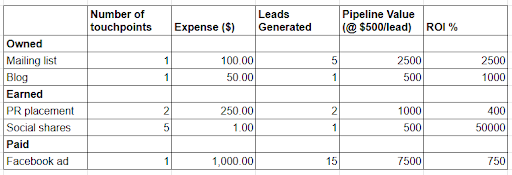
This example is assuming the key metric being tracked is leads generated. If it were brand awareness instead, you could simply look at the number of new visitors.
Assuming that each lead contributes to a pipeline of $500 in a year, the mailing list alone, with five leads generated, contributes to a pipeline of $2500. This is over a basic $100 expense (mostly in tools and human resources).
Since this is a lead generation campaign, you will notice that a PR placement has generated relatively lower qualified leads compared to alternative opportunities like Facebook ads or a mailing list.
As such, it may not be prudent to invest in another PR placement campaign. You could instead channel this investment into an alternate channel that delivers good results.
For example, since social shares deliver such high ROI, could you drive an influencer outreach campaign to reach other social media users with high followings to share your content? If you want to remain budget-conscious, you could also invest in a referral marketing platform that can pay influencers based on successful leads generated.
Rinse and repeat
A lot of content distribution planning involves minor iterations towards optimization. Understanding what works and what doesn’t, and repeating the process with subtle changes, contributed to a stronger and more effective campaign over time.
It is, however, important to reiterate that campaigns need to be compared with other, similar campaigns. For instance, it may be counterproductive to use learnings from a brand awareness campaign and deploy them in a lead gen campaign.
Content distribution planning is just one piece of the puzzle
Content marketing involves a lot of steps, and content distribution planning is just one of the many steps. However, failure to invest in a strong and reliable plan could bring down the ROI for your campaigns quite dramatically.
At the same time, it is important to acknowledge that a strong content distribution plan alone is not enough to save your content marketing campaign. You will need a robust content calendar, a lead acquisition strategy, strong content experiences, an adequate budget, and a willingness to fail in order to succeed.
These factors ensure that your content marketing team continues to enjoy the freedom and the bandwidth necessary to run a sustainable campaign.
Meet Foleon
Unlike PDFs, Foleon Docs unlock insights about your audience, individual contacts, and content performance.

Anand Srinivasan runs LeadJoint, a cold email agency that provides SaaS businesses, agencies, and consultants with a cost-effective solution to generate new leads for their business.
Want to write for the Foleon blog? Here's how to submit a guest post.