
Search doesn’t work the way it used to. This blog explores how AI-driven search is reshaping content optimization guidelines in 2026.
Key takeaways:
- AI rewrites, not ranks: AI systems don't just rank your content — they transform it into conversational snippets and recommendations. Structure and expertise determine whether your content gets cited or ignored.
- Zero-click is the new normal: Users increasingly get answers without clicking through. Optimize for visibility within AI-generated responses, not just traditional search rankings.
- Topic authority over keywords: AI evaluates a comprehensive understanding across related questions. Demonstrate expertise across your domain, not just isolated keyword targets.
- Structure signals trust: Content with clear headers and logical sequencing is 2.8 times more likely to appear in AI search results. Nearly 80% of ChatGPT citations use lists.
- Multi-format consistency wins: AI pulls from an average of seven sources across platforms. Maintain consistent messaging across channels — from Reddit to YouTube to owned content.
- New metrics matter: Track AI share of voice (how often you're cited in AI answers) alongside traditional SEO. Leading brands appear in up to 59.4% of AI responses vs. 17% for average brands.
- Foleon solves the gating dilemma: Unlike PDFs, Foleon Docs remain fully indexable by AI while still allowing strategic gating — no tradeoff between discoverability and lead capture.
In this guide:
- How has AI-driven search transformed the search landscape?
- What is the impact of AI on brands and content teams?
- What are the new rules of content optimization for 2026?
- How does Foleon help you build AI-optimized content?
- How do you measure success in an AI-driven search world?
People no longer scan ten blue links and decide where to click. They ask a question. They get an answer. Sometimes they never leave the search interface at all.
AI Overviews, AI answers, and multimodal search have turned discovery into a conversation. Your content still matters. But the way it shows up has changed completely.
In other words, traditional SEO alone won’t carry you through 2026.
Rankings still help, yes. But they’re not the only thing that controls visibility. AI systems now decide which sources searchers see and trust. If your content doesn’t fit how those systems read and reason, AI ignores it.
Let’s explore how AI-driven search works today and how to adapt your content without sacrificing quality.
How AI-driven search has transformed the search landscape
AI-driven search focuses on answers, not pages. And you see this in how search engines now answer the question directly. (People no longer need to click through to a site.)
This shift is known as zero-click behavior. Users aren’t lazy. The interface does the work for them.
This means that semantic relevance matters more than keyword density. AI systems evaluate meaning across a topic, avoiding repetition of terms. They look for coverage, clarity, and consistency.
In other words, topic depth now acts as a filter.
Sites that only answer one narrow question in isolation rarely make the cut. AI prefers sources that demonstrate understanding across related questions and scenarios.
This shift already affects traffic patterns. According to SEMrush, AI platforms have increased traffic for 43% of marketers.
And it’s not that it doesn’t help the other 57%. That remaining gap shows how much opportunity still exists for teams that adjust their content for AI-driven search.
The impact on brands and content teams
It turns the information within your articles into conversational snippets. Your guides turn into short explanations. Your comparison pages become recommendations. But that only happens if the system trusts the source.
Trust now depends on structure, expertise, and verifiable signals. For content teams, this means investing more time in each piece. You need to focus on clarity over volume.
And the payoff can be significant.
According to Webflow’s VP of Growth, Josh Grant, AI-driven traffic converts 600% better than traditional SEO traffic. That jump comes from user intent alignment. Users arrive after an AI system has already qualified the answer.
But visibility still varies widely as it relies on brands to optimize their content to appear credible to AI search tools.
As Athena’s 2025 State of AI Search report found, the average brand appears in fewer than 17% of AI-generated discovery answers. But leading brands appear in up to 59.4% of responses.
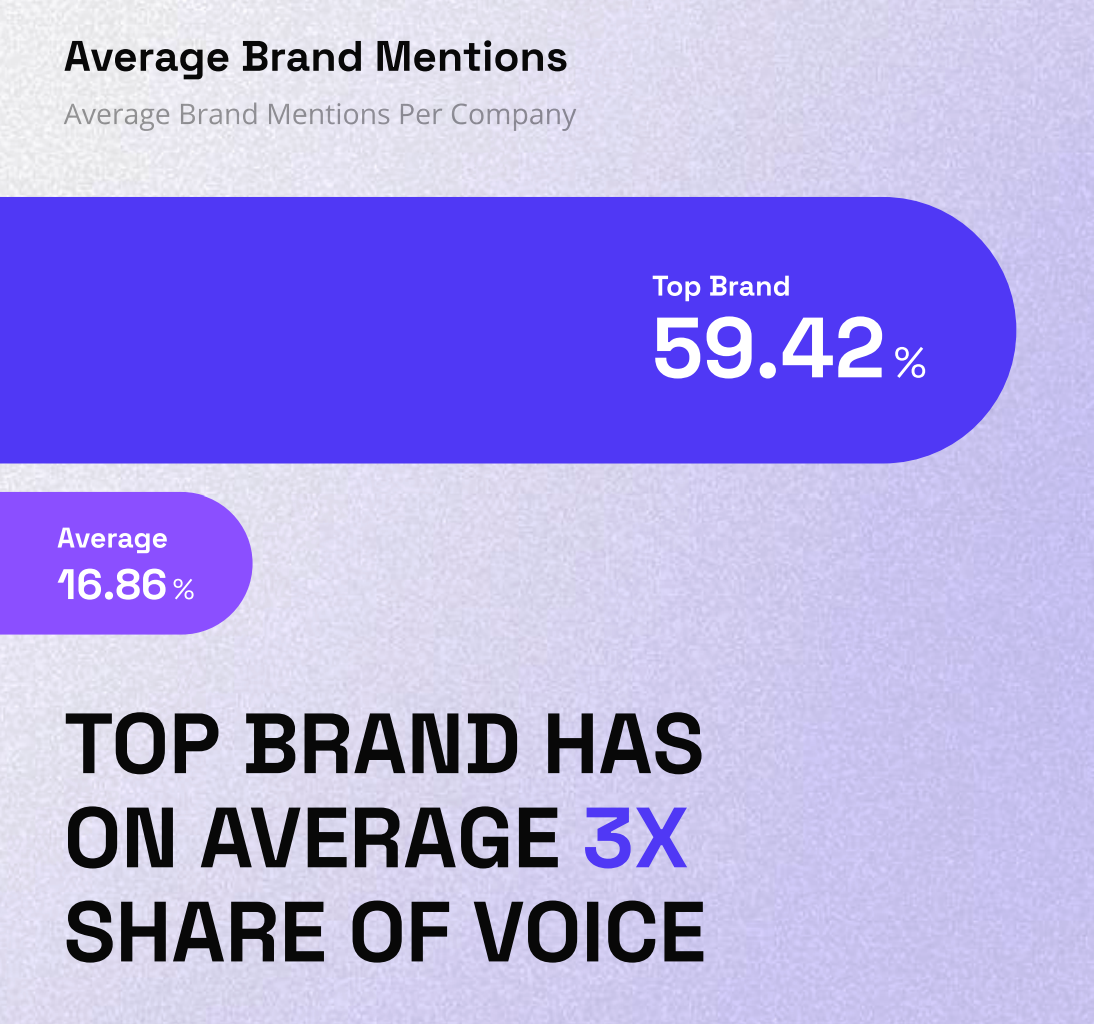
This gap shows how quickly authority compounds once large language models and AI systems recognize a reliable source.
The new rules of content optimization for 2026
Marketers already see the change. HubSpot’s 2026 State of Marketing Report found that 24% of marketers are modifying their strategies to account for AI search visibility.
Here are the rules that reflect how AI systems evaluate content today, so you can prioritize your place in AI search.
Rule #1: Build topic authority, not just keyword lists
Keyword lists alone no longer signal relevance to AI-driven search engines (i.e., generative engines).
AI systems don’t evaluate content based on how many phrases you target. They assess whether your content demonstrates a real understanding and includes multiple citations (aka backlinks) across multiple platforms.
Search Engine Land says, “GEO benefits from strategic presence across platforms where AI tools discover information.”
True authority comes from covering a subject from multiple angles and showing how related ideas connect. AI models map these relationships to determine whether a source consistently adds value across different user questions.
HubSpot, a B2B SaaS marketing company, is a perfect example. They appear in traditional search and AI-powered search as a B2B SaaS leader. HubSpot’s content consistently demonstrates its expertise and knowledge of all things Software-as-a-Service across two important ecosystems:
- Community-driven surfaces (i.e., Reddit, Wikipedia, etc.)
- Owned pages (i.e., LinkedIn, Yelp, etc.)
Over time, these content ecosystems establish semantic relevance. When users ask AI systems about B2B marketing, SaaS content, and B2B SaaS trends, the model can connect those questions back to a broad, reliable body of knowledge. That consistency signals trust.
This is how topic authority compounds. Rather than optimizing for individual keywords, HubSpot positions itself as a dependable source within its domain. As a result, AI systems are more likely to surface the brand for relevant searches where expertise and context matter.
Rule #2: Show expertise and verifiable credibility
AI evaluates trust differently from traditional search engines.
Instead of taking claims at face value, AI systems look for patterns that signal real expertise. They assess how well a source explains a topic across connected questions, use cases, and stages of a buyer or user journey. In practice, that means credibility comes from depth and coherence, not self-promotion.
Rather than targeting isolated keywords, AI evaluates topical authority by mapping how effectively a source connects related needs into a cohesive knowledge graph.
For B2B SaaS brands, authority means covering the full buying lifecycle — from problem definition and stakeholder alignment through vendor evaluation, implementation, and scalability. AI systems favor content ecosystems that reflect how real buying committees think, not isolated posts optimized for single keywords.
When someone asks, “Is free software good enough for my company?”, AI doesn’t prioritize feature lists. It elevates sources that address the total cost of ownership, security, compliance, integrations, data portability, and the risks of outgrowing entry-level tools.
A good example of AI-ready product content comes from property management SaaS brand Hemlane. Their content explains how their free landlord software fits into reporting workflows, regulatory requirements, tenant communication, and portfolio growth — not just which features are included.
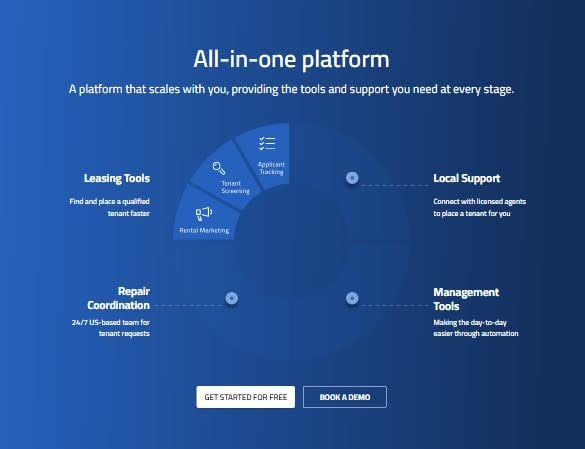
Structured, modular content makes this depth visible. Interconnected guides, comparison frameworks, and implementation roadmaps create a coherent narrative across the buyer journey. That cohesion strengthens user trust and signals strategic authority to AI systems — increasing the likelihood of being surfaced in AI-generated answers.
Rule #3: Structure content for AI (and human) readability
Structure guides understanding for AI search systems. They read the site hierarchy before they dive into the meaning.
Clear sequencing is the best way to show the system how ideas relate. Strong headers are the backbone of that sequencing, so use them to answer the questions AI is looking for.
Research supports this. The AirOps 2026 State of AI Search report shows that content with good sequential structure and clear headers is 2.8 times more likely to appear in AI search results.
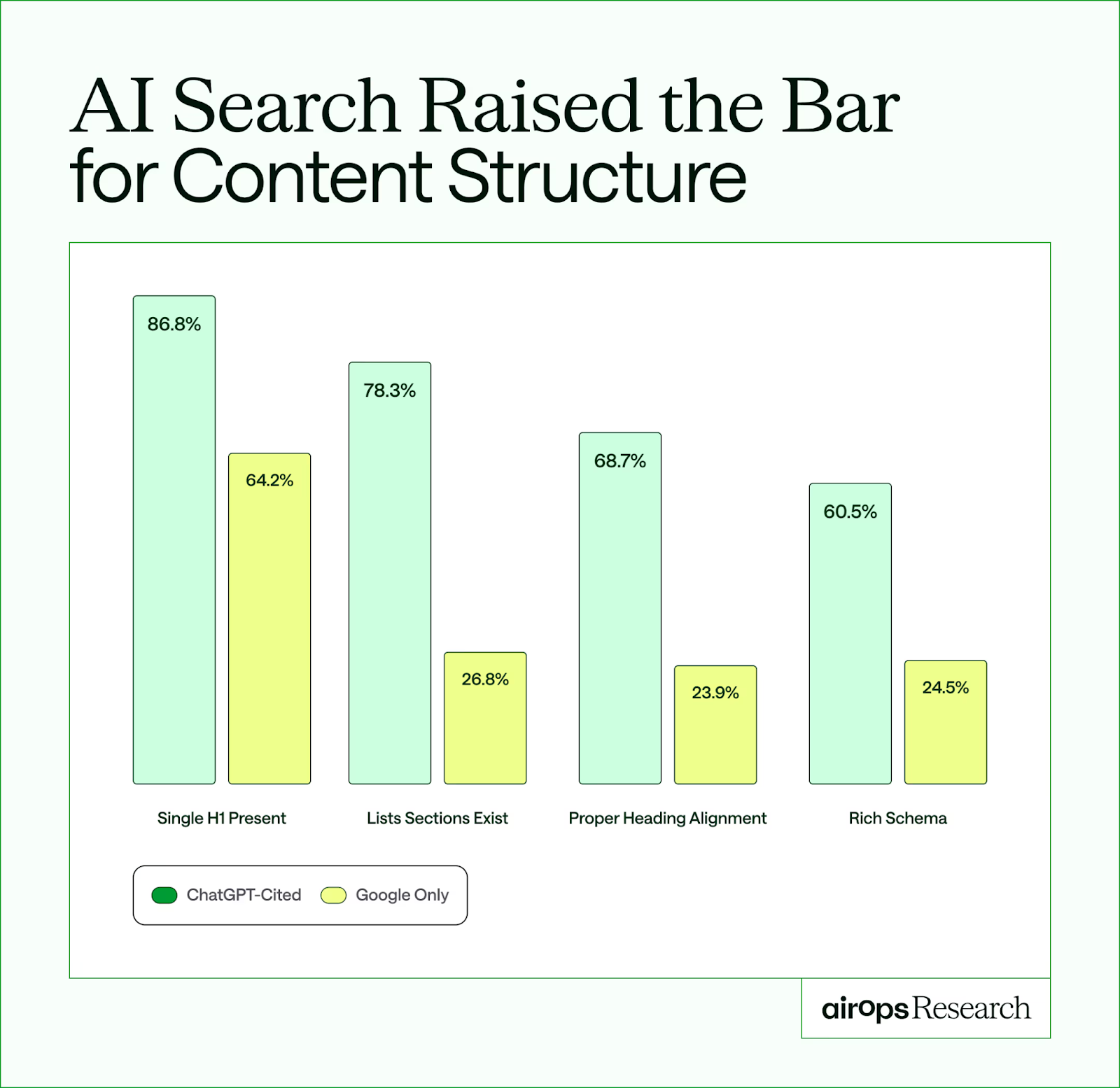
(Image Source)
On top of that, nearly 80% of pages that ChatGPT cites use lists to organize important information.
The best part is that this logical flow also helps humans scan your content. And when content feels more readable, visitors stay on your site longer, too.
Rule #4: Use multi-format content that enhances understanding
Athena’s research shows that AI models pull from an average of seven different sources, including Reddit and YouTube. They synthesize meaning across channels and formats to form a clearer picture of an answer.
This makes two main things essential:
- Consistency: You need your information to show up the same way everywhere so AI doesn’t feed searchers the wrong answer.
- Cross-posting: Creating content in multiple formats across different channels reinforces AI’s understanding of your core message.
With consistent, multi-format content, you improve AI comprehension, since you provide a range of sources that make your information easier to grasp.
Rule #5: Strengthen entity signals and add schema
AI needs to understand what something is before it can recommend it. Entity and schema give it that context.
Entity signals tell search engines what something actually is, such as a business, product, or service.
That means spelling things out clearly.
Write your brand, products, services, and contact details consistently across your site and social content. Say what you are, who you serve, and what you offer in plain language — especially on core pages like your homepage and key guides.
A schema is a structured framework that labels information on your site in a way search engines can read. It shows how your business, products, and content connect to related ideas.
Add schema to reinforce your entity signals.
Mark up your business details, products, reviews, and content types so search engines can read them without guessing. When your pages clearly define what each entity is and how it relates to the others, AI can place your content more confidently in relevant answers.
Rule #6: Create meaningful internal and external link connections
To AI systems, links act as contextual validation.
Internal and external links are both essential components of any AI marketing strategy. AI-driven discovery models evaluate how ideas connect across a domain, not just how well a single page ranks. Internal links reinforce topical depth by showing how your product pages, thought leadership, case studies, and solution content relate to one another. External links demonstrate that your content exists within — and contributes to — a broader industry conversation.
In AI marketing, authority is built through structured knowledge. A well-linked content ecosystem helps AI systems understand your areas of specialization, the consistency of your messaging, and the relationships between your core themes. Internal linking strengthens semantic clarity across your site, while relevant external references reinforce credibility signals beyond your owned media.
When your linking strategy is intentional and aligned with your AI marketing strategy, you create a network of context that AI systems can confidently interpret. That interpretability directly increases the likelihood that your content will be surfaced, summarized, and cited in AI-generated responses.
How Foleon helps you build AI-optimized content
Putting these rules into practice comes down to structure and clarity. The format you choose shapes how well your content performs.
This is where Foleon helps, by giving teams a format built for AI discoverability.
Modular building blocks improve AI parsing
Foleon Docs render complete, structured HTML on the server. Crawlers receive the full content immediately. Headings, text, and metadata remain intact.
That predictability helps AI understand hierarchy and meaning. But don’t worry, the building blocks don’t force everything into the same shape. The modular layouts keep each section consistent without restricting your creativity.
Interactive elements boost engagement signals
With Foleon, interactivity loads after indexing. This means that AI systems read the full content first, and users engage with it after.
This is a huge win because you usually have to choose between AI readability and engaging content experiences.
This approach supports both. There’s comprehension and retention for AI. Then the engagement that follows reinforces content quality by showing that readers find real value in what they’re reading.
Solving the gating versus discoverability tradeoff
Gated PDFs hide content from AI systems. This blocks discoverability.
Foleon removes that tradeoff.
Content remains indexable while teams choose where to gate. And no matter which you choose — front-gating, mid-gating, or end-gating — crawlers can still read the full document before forms appear.
Analytics to continuously optimize content
Foleon’s analytics show how people interact with your content on a micro-level, from scroll depth to dwell time and clicks. That makes continuous optimization easier as you can refine structure and clarity based on real engagement.
This ongoing refinement aligns with how AI systems evaluate content over time. As models revisit sources to generate answers, they’re more likely to cite content that stays clear and useful.
Measuring success in an AI-driven search world
With all of this in mind, let’s take a look at how to measure content success now that AI is in the works.
New KPIs for 2026
Traditional SEO metrics only tell part of the story. Rankings and clicks still matter, but they don’t fully capture how brands earn visibility in AI-driven search environments.
As users increasingly rely on AI-generated answers, many traditional SEO tools built around tracking “blue link” rankings are becoming less effective. This shift highlights the growing distinction between GEO vs SEO.
SEO focuses on keywords, backlinks, and search rankings. GEO, on the other hand, reflects how generative engines interpret, summarize, and cite information. Instead of optimizing only for search engine results pages, brands now need to optimize for how large language models extract facts, attribute expertise, and surface sources inside AI overviews.
This is where AI share of voice analysis becomes critical. It tracks how often your brand appears as a cited or referenced source within AI-generated responses for high-value queries. Unlike rankings, this metric reflects real influence in answer-driven search.
If your content isn’t appearing in AI-generated answers where it should, that’s a signal. It often points to gaps in topical authority, weak entity signals, or a lack of verifiable data and expert insight. Strengthening these areas helps generative models confidently reference your content, improving visibility where users are actually getting their answers.
Iterating with AI-search insights
When AI systems skip your content or summarize it poorly, treat that as feedback.
Look at where your brand doesn’t appear, or where explanations feel thin in AI-generated answers. These gaps usually indicate missing context or an unclear structure.
Use this insight to strengthen key sections and add supporting explanations.
Continuous improvement cycle
AI-driven search rewards content that stays current and clear.
Make sure to regularly update high-impact content to maintain relevance. Consistent improvement builds authority and makes it easier for AI systems to trust and reuse your content.
Conclusion
Visibility now happens before the click. An AI-driven search rewards structure, clarity, credibility, and depth.
Brands that adapt to AI search preferences early will build durable authority inside AI answers, as well as Google Search.
One of the easiest ways to do this is to invest in flexible formats that position your content for long-term discovery.
Ready to take your first step towards AI discoverability?
Explore how Foleon helps teams build AI-ready content experiences that both humans and LLMs will love.
Meet Foleon
Unlike PDFs, Foleon Docs unlock insights about your audience, individual contacts, and content performance.


Ioana is a business strategist and content writer for B2B tech and SaaS brands. She also helps aspiring entrepreneurs build remote businesses. Born in Transylvania and raised in Texas, Ioana has been living the digital nomad life since 2016. When she’s not writing, you can catch her snorkeling, exploring, or enjoying a café con leche in Barcelona!
Want to write for the Foleon blog? Here's how to submit a guest post.

.png?width=854&name=Q&A%20Short%20blog%202%20how%20much%20of%20the%20buyer%E2%80%99s%20journey%20is%20digital%20(1).png)