%20(1).png?width=1456&name=5%20Content%20Challenges%20Facing%20Insurance%20Brokers%20(and%20How%20the%20Top%2010%20Solve%20Them)%20(1).png)
This blog article breaks down the major content hurdles insurance brokerage teams are dealing with in 2026, and how the BI top 10 brokerages solve them.
In this guide:
- Challenge 1: Standing out in a sea of sameness
- Challenge 2: Staying consistent during inorganic growth
- Challenge 3: Dealing with chaos during open enrollment
- Challenge 4: A lack of insight into readership
- Challenge 5: Confusing clients with complex products
Marketing and comms teams in the insurance brokerage space are caught between a rock and a hard place right now. On one hand, you’ve got a softening market where competition is fiercer than ever. And on the other, you’re looking at 15-25% growth targets (while your headcount stays flatter than a pancake).
Not to mention, the chaos of open enrollment, the struggle to stand out in a traditionally, quote unquote, “boring” category, and that’s before you even throw mergers and acquisitions into the mix.
But in the face of these hurdles, a few leading brokerages aren’t just surviving, they’re thriving. Here are 5 major content challenges facing insurance brokers (and how the top 10 are clearing them).
Challenge 1: Standing out in a sea of sameness
The insurance landscape is saturated. If your digital marketing looks exactly like the broker across the street’s, you’ve already lost the battle for differentiation. And, nowadays, you’re not just competing against your actual competitors for your buyer’s attention — you’re also up against TikTok, Reels, and John from Accounts' lukewarm takes on LinkedIn (sorry, John). To stand out, you’ve got to be strategic and make some bold moves.
How the top 10 solve it: Borrowing tactics from B2C
The leaders in the insurance space aren't just “going digital” and calling it a day. They’re thinking strategically about how to disrupt the space and impress their clients by taking a leaf out of consumer brands' playbook. For some, that means stepping away from corporate blue and embracing branding that’s more reminiscent of a consumer tech brand than a traditional financial services firm.
Others are looking to modernize their insurance content and deliver digital experiences that match the seamlessness of Netflix and Amazon. As Deloitte’s 2026 global insurance outlook notes, “in addition to their traditional role of helping employers select benefit products and carriers, [brokerages] can increasingly select digital technologies that increase value and ease for stakeholders.” Winning brokerages know that the modern policyholder no longer compares their insurance provider to other carriers — they compare it to the last great app they used.
Real-world example: Vitality
Leading insurance firm Vitality decided to do all of the above.
Rather than sticking to the old school insurance marketing playbook, they decided to write their own rules. As Becky Bargh, Vitality’s editorial and content manager, puts it: “Traditionally, the insurance industry can seem quite rigid or maybe a little bit old school, but there's no reason for it to be. We're in a very new generation now where things are changing all the time, and I think insurance should change with it, too. We're nonstop trying to come up with new and innovative ways to meet our members and prospects.”
With bright pink branding and a sausage dog mascot, Vitality is no stranger to sticking out in the insurance space. And this philosophy extends to their digital content marketing strategy, too.
The team decided to recreate their popular magazine in a digital format, overcoming the limitations of print by incorporating video, audio, and interactive experiences that their audiences could enjoy on the go. And in the process, the team went from producing one printed magazine a year to four digital and seasonal editions!
Wondering how they managed it? Check out the full Vitality story here.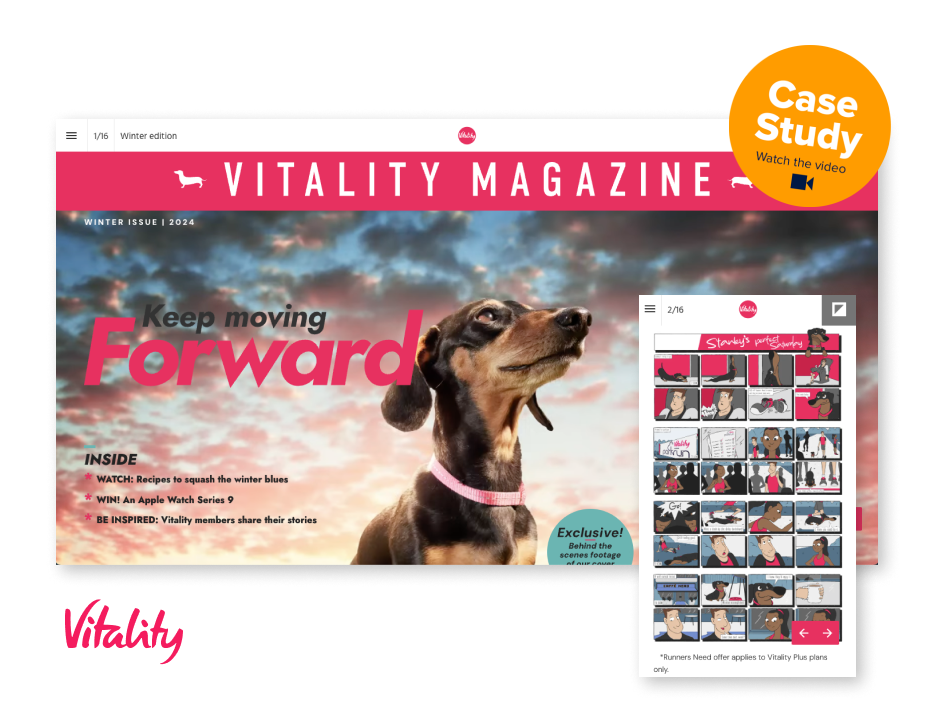
Challenge 2: Staying consistent during inorganic growth
Growth in the insurance world is often “inorganic”, which is a fancy way of saying “we acquired or merged with a bunch of other insurance brands”. To give you an idea of the scale here, last year the insurance sector reported $31.8 billion in announced deals from June 1 through November 30, 2025. And top firm Arthur J. Gallagher completed a whopping 33 mergers in 2025 alone. For brokerage marketing teams, the fallout of inorganic growth often shows up as operational friction.
When a global insurance brokerage acquires three other smaller insurance agencies in a year, content and marketing collateral can easily turn into a Frankenstein’s monster of different colors and logos, conflicting digital strategies, and outdated information — that you now need to update across four brands and teams, instead of just one. Good luck!
The inconsistency that often comes with inorganic can also be a brand trust killer. If a client receives a polished, modern report from the New York office and a 2004-era Word doc from the London branch, that hard-earned trust evaporates. For clients and potential clients, it’s a signal for low operational maturity. Yikes.
How the top 10 solve it: Brand consistency at scale
How do the top-performing brokerages manage to stay consistent in the face of inorganic growth? Spoiler: They’re not wasting hours manually reviewing every single PDF report or benefits guide, looking a rogue font or color. Instead, they build systems that give local and acquired teams the flexibility they need without breaking global standards. Keeping the brand locked down by default means teams can move fast and deliver a consistent experience, whether they’re in Sydney or Seattle.
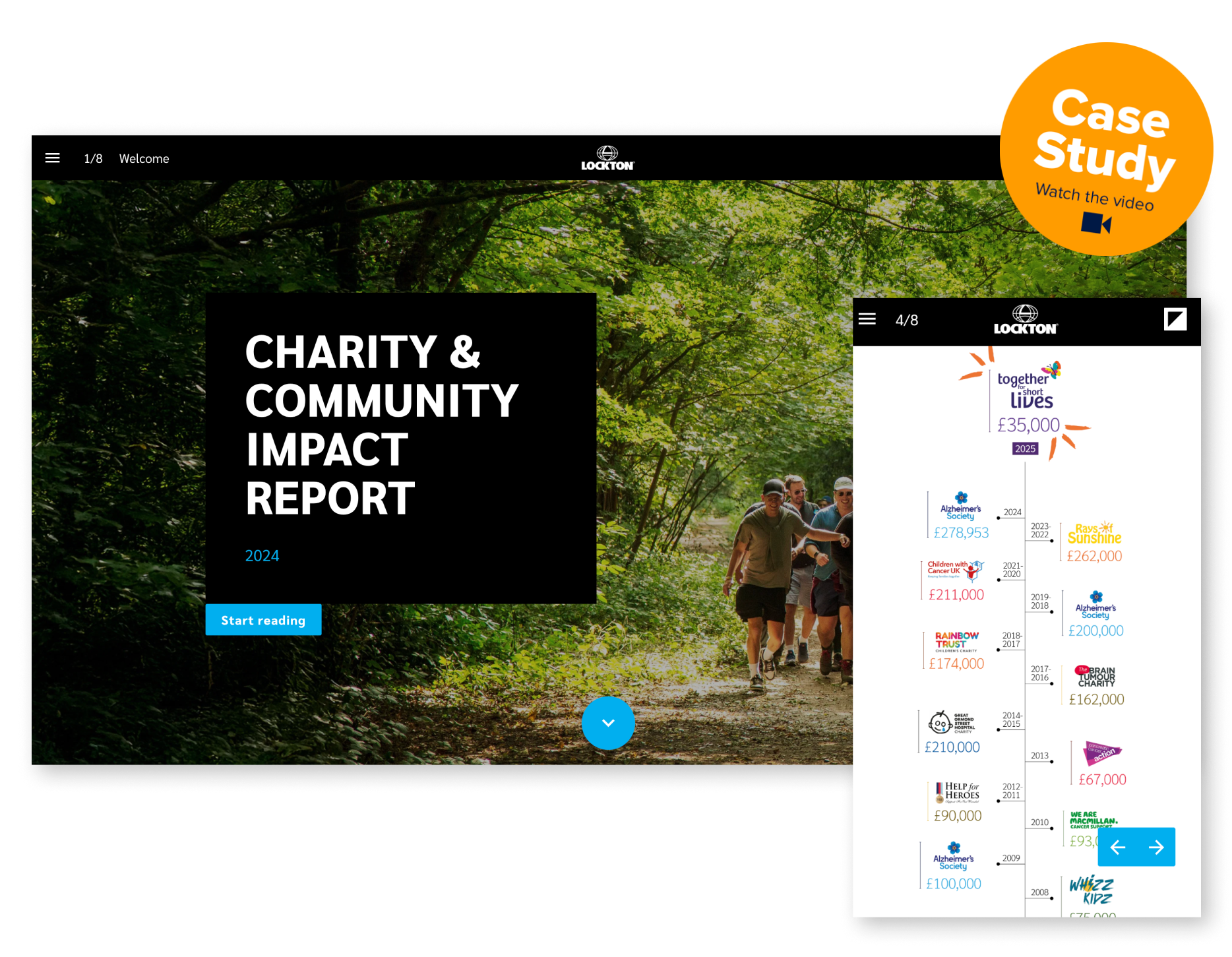
Real-world example: Lockton
With 135 offices worldwide, managing content creation used to be a nightmare for Lockton. And in a business where reputation is everything, they couldn't risk “rogue” content getting out the door.
Using Foleon, they empowered their teams to create content locally while maintaining strict central control over brand standards. As Ashleigh Arthur, Head of Creative UK & Europe, puts it: “Now that we've introduced Foleon, we can really be very consistent. We are able to create content a lot quicker.”
In doing so, they went from a chaotic and awkward growth phase into one big brand powerhouse.
Curious how they pulled it off? Check out the full Lockton story here.
Challenge 3: Dealing with chaos during Open Enrollment
The Q4 crunch is the ultimate stress test for a marketing org in insurance. For insurance brokerages, Open Enrollment means tight deadlines, the astronomical costs of printing physical materials, and the increasing pressure to retain clients, all coming together at once.
In the past, brokers would spend months (and a small fortune) on printed benefits guides that employees immediately threw in the trash. In 2026, with sustainability mandates and rising costs, the paper route isn't just pricy, it’s environmentally irresponsible.
But, even more pressing for brokerage teams: Print creation comes with serious design bottlenecks, which can end up causing chaos come Open Enrollment. Manually updating changing rates is always a pain, but if you’ve got to order a reprint every time something changes, that adds up fast.
How the top 10 solve it: Swapping static creation for interactive experiences
Top brokers are replacing the “thick envelope” with interactive digital guides that anyone in the org can easily create or adapt. These aren't just faster to produce — they’re significantly cheaper and have proven to be more effective at driving long-term retention. And they allow for last-minute changes to plan details without having to pulp 5,000 copies of a brochure.
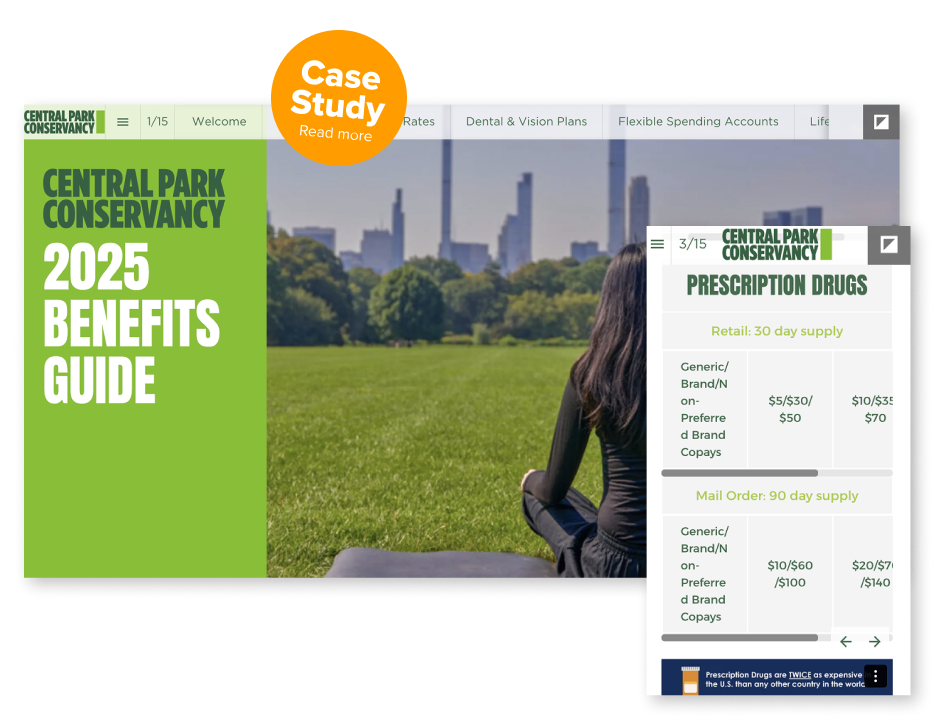
Real-world example: Alliant
Alliant stopped the printing presses and went digital to save both time and money. By using Foleon for their benefits guides, they saved over $4,000 per client in production and shipping costs alone. And instead of spending a full week building a 25-page physical guide, they now get it done in one to two days. Plus, with the flexibility of digital content, they can respond to client changes in real time, proving their value as an agile partner.
How did Alliant stop surviving and start thriving during OE? Read the full story to find out.
Challenge 4: A lack of insights into readership (PDFs)
When you send a PDF, you’re flying blind. Did the client open it? Did they spend ten minutes reading the “Medical Benefits” section, or did they close it immediately? Without data, your digital marketing strategy is just a series of semi-educated guesses. You can’t optimize what you can’t see (and you certainly can't prove ROI to a skeptical CFO).
How the top 10 solve it: Using data to inform action
Modern brokerage teams aren’t relying on the vanity metric of “downloads” alone to inform their digital marketing and content efforts .
They want to see bounce rates, time-on-page, and click-through rates. This data allows them to follow up with potential and existing clients at the exact right moment with the exact right message. If you know a prospect has read a specific section three times, you know exactly what your next call should be about.
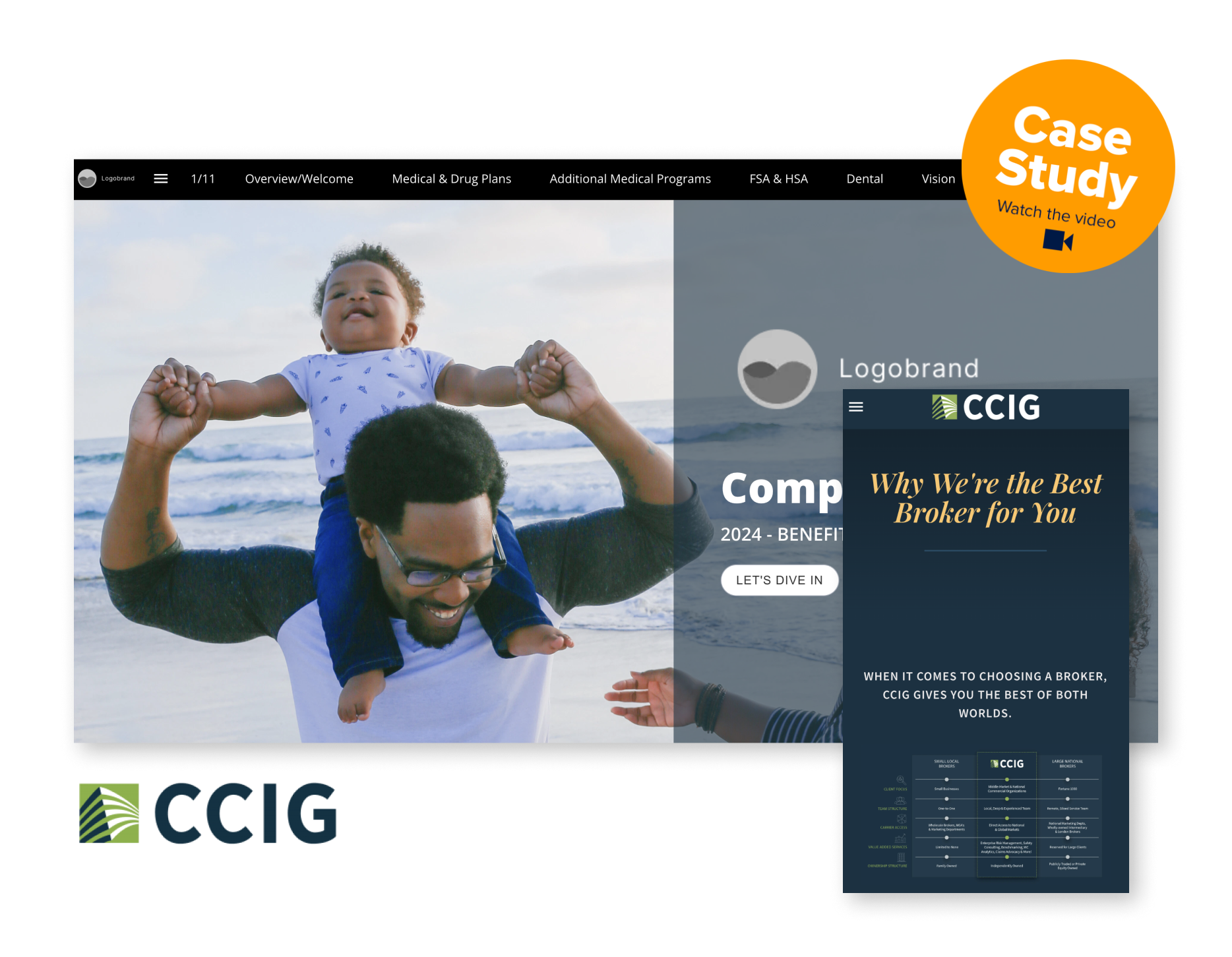
Real-world example: CCIG
CCIG stopped guessing and started measuring. Before Foleon, their content creation was scattered across PowerPoint, HubSpot, and Adobe. And once a PDF was sent, it was impossible to track or update. By moving to interactive digital guides, they gained in-depth insights that informed their strategy. With an understanding of what clients are reading (and what they’re skipping), they’re able to be more targeted in their follow-up. As the brokerage’s Marketing Director, Davis Snedeker put it: “Analytics help us focus our content where it counts.”
Check out the full CCIG x Foleon story to learn more.
Challenge 5: Confusing clients with complex products
Insurance is complicated. No one wakes up excited to read about aggregate stop-loss limits (probably). And if your target audience is confused by your offering, they will stay with their org’s current provider to avoid the headache of switching. Confused customers don't buy.
Besides being clear, insurance content needs to be accessible. If a client or employee has to “pinch and zoom” on their phone to read your benefits guide, they will close it. If your content doesn't work on a smartphone in 2026, you’ve already lost the massive cohort of mobile-first decision-makers.
How the top 10 solve it: Interactive insurance content that tells a story
The leaders are ditching the dreaded wall of text for modular, visual storytelling. They use interactive charts, videos, and responsive layouts to ensure their message lands, whether the client is at a desk or on a train. They use “scrollytelling” to lead the reader through complex risk scenarios in a way that feels like a conversation, not a lecture.
Real-world example: NFP
NFP reinvented its benefits communications by focusing on the user experience first and foremost. By moving away from dense and dull text-heavy formats to interactive, media-rich and responsive experiences, they ensured their content was “perfectly optimized for tablet and mobile” and readable on any device, making it easy for employees to actually understand their coverage.
Discover how NFP reinvented the benefits guides game with the help of Foleon.

Final thoughts on digital marketing for insurance brokers
Leading insurance firms and brokerages like Lockton, Vitality, and Alliant aren’t just building better content — they’re building smarter operations. Faster production. Stronger engagement. Actual visibility. No fluff, just real results.
With a digital-first approach, you can:
- Help teams move faster with fewer bottlenecks
- Make benefits easier to understand (and harder to ignore)
- Use data to steer smarter follow-ups and campaigns
Join the top 10 brokerages
There’s a reason all of the top 10 US insurance brokerages have already moved their benefits guides to Foleon. They know that in 2026, the experience is the product.
Ready to see how the market leaders are winning? Explore Foleon for Insurance.
Meet Foleon
Unlike PDFs, Foleon Docs unlock insights about your audience, individual contacts, and content performance.

Clem is a Content Marketer here at Foleon. With a background in B2B SaaS and copywriting, she’s all about providing audiences with actionable, relevant content — minus the buzzwords.
Want to write for the Foleon blog? Here's how to submit a guest post.