
Enterprise teams are producing more content than ever. Yet, most of it never gets used.
These assets go untouched after they’re created, not because they're poor quality, but because they are hard to find or hard to reuse.
In fact, 80% of stored data doesn't generate business value. If your content library is bloated but delivers little impact, you’re not alone.
This article tackles why your content library is working against your enterprise — and the steps you need to take to make it work for your business.
Key takeaways:
- The 80% waste trap: Most enterprise content goes unused because it’s hard to find or difficult to repurpose. High volume doesn't equal high value; 80% of business data currently generates zero impact.
- Findability is functionality: Content only has value if it can be found. Inconsistent tagging and departmental silos force teams to recreate assets from scratch, wasting time and inflating production costs.
- Utility over volume: Successful libraries aren't built on the quantity of assets but on their usefulness. Every piece of content should support a specific buyer intent or sales scenario.
- Modular design wins: Designing content for reuse from the start — using flexible layouts and adaptable formats — allows teams to scale messaging across regions without doubling the workload.
- Centralization kills silos: Fragmented storage leads to inconsistent messaging. A "single source of truth" ensures that sales and marketing teams always pull from the most current, high-performing assets.
In this guide:
-
Why do enterprise content libraries break down?
-
What's the real business impact of unused content?
- How do you set up an effective content library?
The 80% problem in enterprise content libraries
Maybe you've heard of the 80-20 rule (aka the Pareto principle). The general idea is simple: 80% of outcomes result from 20% of inputs.
In business, the goal is to spot the most effective and productive inputs to get the best possible results.
This essentially applies to your content operations, too.
But too often, content marketing at an enterprise looks like this: You pour 100% of your efforts into your content creation. In the end, only 20% of your assets engage and convert, and about 80% get wasted altogether.
On paper, enterprise content libraries look successful. They’re full of sales collateral, case studies, one-pagers, campaign assets, and regional variations. But in practice, they often slow teams down.
Sales reps can’t quickly find what they need. Marketing teams keep recreating assets they already have. Regional teams build their own versions because the “official” ones don’t quite fit.
The result? A growing library that adds complexity instead of value. That’s where content governance becomes essential. But first, let’s understand why your content library doesn’t work.
Why enterprise content libraries break down
Enterprise content management (ECM) refers to the systems and processes organizations use to store, remove, organize, and distribute content at scale, from internal documentation to enterprise content marketing. Done right, enterprise content management improves efficiency, speeds up collaboration, reduces risk, and ultimately supports revenue growth.
This isn't surprising when you consider that 93% of companies rely heavily on data collaboration to drive revenue. Effective content management ensures that the high-value data in content libraries is accessible, shareable, and ready to be put to work.
Yet despite significant investments, many enterprise content libraries still end up disorganized and underused.
The fact is, most content libraries don’t fail all at once. They break down gradually as scalability and complexity increase.
Common reasons for this include:
- Content silos across teams and regions: Sales, marketing, product, and regional teams store content in different systems with limited visibility or alignment. How can they access content when they need it most if access is restricted?
- Poor findability and inconsistent tagging: Assets aren’t labeled consistently, making them hard to surface when teams are under pressure. Think about it: What good is your data-driven content marketing if your assets can’t be found and used?
- One-off campaign assets with no plan for reuse: Content is created for a specific moment, then forgotten once the campaign ends. Content teams don’t have a conscious effort to keep these assets and repurpose them in the future.
Over time, the library becomes a storage space rather than a working tool.
The real business impact of unused content
Unused content isn’t just an organizational issue. It has real business consequences.
When content gathers dust, you end up with:
- Time wasted recreating existing assets: Teams rebuild decks, one-pagers, proposals, and other content pieces because it’s faster than searching.
- Slower go-to-market and inconsistent messaging: Without a shared source of truth, teams pitch differently and sometimes inaccurately.
- Higher content costs with lower ROI: More content gets produced, but less of it contributes to the pipeline or revenue.
The more content you create without fixing the underlying system, the worse the problem gets.
That’s why it’s important to master content governance. In this case, this means establishing a structured, organized enterprise content library — and setting up processes to maintain it.
How to set up an effective content library
High-performing content libraries are designed for use, not just storage. They focus on helping teams act faster and more consistently. That’s why it’s vital to implement content lifecycle management to ensure your assets are not only kept but also used and repurposed.
Here’s what you can do:
1. Focus on creating relevant, high-value content
Content can take many forms, such as blog posts, case studies, white papers, and annual reports. However, not all formats perform equally.
According to Forbes, the top-performing content formats in marketing include video clips (45%), short-form content (31%), success stories (28%), long-form articles (24%), and case studies (19%).
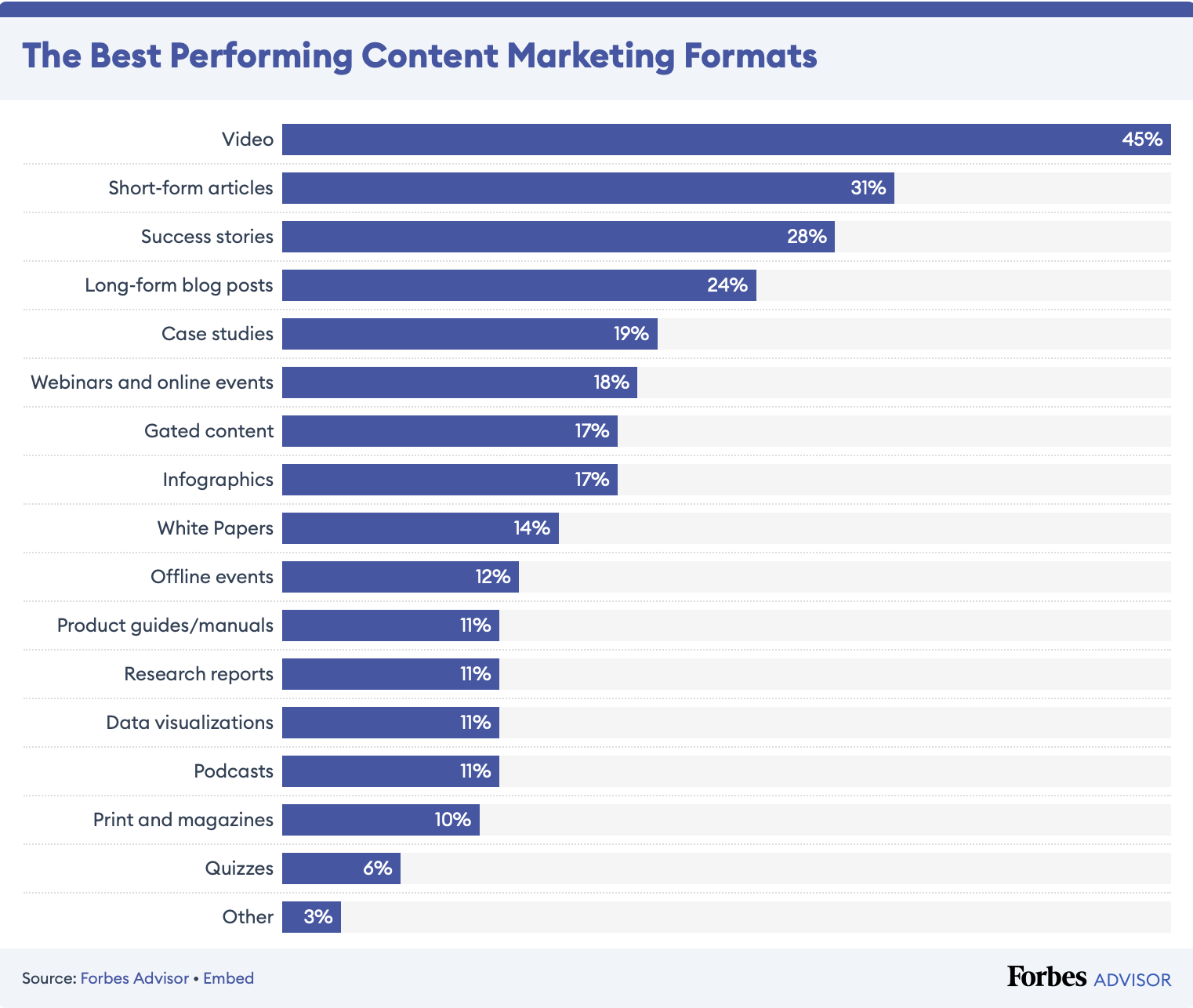
The key is to understand what works for your audience and build your library with content that delivers clear value. Each asset should support a real sales conversation or buyer decision, rather than existing solely for a one-off campaign or internal request. An effective content library starts with fewer, but better assets.
Take it from Tyler Denk, Co-founder and CEO at beehiiv. As a company that helps content creators and publishers create newsletters, he knows quite well what makes an effective content library.
Denk says, “The best content libraries aren’t built on volume — they’re built on usefulness. When content is created with a clear purpose and audience in mind, it’s far more likely to be reused and repurposed, eventually driving positive results.”
2. Organize assets around use cases and buyer intent
If you want your content library to be successful, you need to structure it around real-world usage, not internal teams or campaign names.
Organize assets by buyer stage, role, industry, or sales scenario. This makes it easier for your team to surface the right content at the exact moment it’s needed.
Let's take a real-world example: Suppose you’re running an agency with a dedicated sales team targeting startups, SMBs, and enterprise clients. If you've organized your content library according to specific cases and valuable resources for each type of business, your sales teams can quickly pull a business proposal and relevant case study based on the prospect’s immediate need.
Content hubs management platforms like Foleon’s Sales Hub are designed for this kind of internal enablement. By creating dedicated sales hubs, organized around real-world scenarios, your sales team will be able to quickly find, personalize, and tweak the content they need to close the deal.
3. Design content for reuse and easy adaptation
An effective content strategy works best when assets are designed with reuse in mind from the start.
In practice, this means building high-performing content to scale across regions, teams, goals, and channels. Templating systems, modular layouts, and flexible formats are key here. With the building blocks in place, teams can tailor messaging and localize content without recreating assets from scratch.
Learn from Brandy Hastings, SEO Strategist at SmartSites. As a digital marketing agency serving businesses of all sizes across different industries, Brandy's team employs deliberate content repurposing for efficiency and productivity
Hastings explains, “When we approach all our marketing materials as reusable assets, a single campaign can generate multiple touchpoints, like blog posts, email sequences, social graphics, and downloadable resources, all without doubling production work.”
She caps by saying, “Ultimately, it’s about creating once and leveraging everywhere to extend the lifespan of every asset.”
4. Make assets easy to find when teams need them
Strong content collaboration depends on speed and clarity.
If content can’t be found quickly, it won’t be used, especially in live sales or customer conversations.
So, clear naming conventions, consistent tagging, organized assets, and intuitive search are essential to helping your team access the right asset in seconds, even under pressure.
Kos Chekanov, CEO at Artkai, suggests streamlining content libraries for easy access and utilization. Having worked with B2B clients for digital product development, he sees the need to establish a highly organized content library for sales and marketing initiatives.
Chekanov shares, “Even the best marketing or sales content loses value if teams can’t find it when they need it. A well-organized library ensures assets are instantly accessible, so your team can focus on engagement rather than searching.”
5. Use a centralized platform without overloading the tech stack
A centralized platform creates a single source of truth. It reduces duplication and confusion while keeping teams aligned around shared assets and workflows.
The goal isn’t tool sprawl; it’s clear ownership and consistent adoption. When all marketing materials and templates live in one central system, teams spend less time hunting for assets and more time using that content to actually help customers and prospects.
As Emily Carter, Content Specialist at Searqle, explains, “Enterprise teams rarely struggle with content production itself. The real issue is visibility and usability. When teams can't quickly identify which assets are current, relevant, or proven to work, content naturally falls out of circulation, regardless of its quality.”
Enterprise content platforms like Foleon bridge the gap between content storage and active collaboration.
By centralizing brand controls and dedicated workspaces into one enterprise-ready ecosystem, Foleon removes the friction of finding content so global teams can focus on scaling it.
Final thoughts on enterprise content libraries
Most enterprise teams don’t have a content shortage — they have a content management problem. That’s why content governance is key.
This approach requires a shift from content accumulation to content performance, from storing assets to enabling real work. When your content library aligns with how your team promotes and sells, your unused assets stop being a cost center and become a business growth driver.
Remember: It's not about how much content you have — it’s how much of it actually works.
Meet Foleon
Unlike PDFs, Foleon Docs unlock insights about your audience, individual contacts, and content performance.


Brooke Webber is a marketing strategist focused on people-first branding, employee engagement, and workplace psychology. She blends data and empathy to craft campaigns that connect, convert, and inspire action.
Want to write for the Foleon blog? Here's how to submit a guest post.