
TL;DR: This blog breaks down what sales teams need from marketing content in 2026 and how to use content for sales more effectively.
Key takeaways:
- Prioritize conversation-ready content: Help reps answer questions and move deals forward.
- Personalize for different buyers by matching content to specific roles, priorities, and concerns.
- Make content easy to use: Easy-to-share assets are more likely to be used.
- Build around buyer questions: Organize content around what people need to know.
- Support the entire journey: Fill content gaps before they slow down deals.
- Use engagement data to guide follow-ups: Let buyer behavior shape the next conversation.
In this guide:
- Why some content gets used, and some gets ignored
- How to Use Content for Sales in 2026
- The assets that help buyers make decisions
- How to make content easier to share and personalize
- Ways to create a more sales-ready content library
Sales teams have access to more collateral than ever before. Blog posts. Case studies. White papers. Product sheets. The list keeps growing.
But many sales teams still struggle to move deals forward.
The problem is that most marketing content was never designed to support sales conversations in the first place. It’s built for awareness, not conversations.
This creates a gap between what marketing produces and what sales actually use.
Let’s take a closer look at what sales teams need from marketing content in 2026, because content only earns its keep when it helps someone make a real decision.
Why most marketing content doesn’t help sales
Here’s why most marketing content doesn’t help sales teams:
It’s built for clicks, not conversations
Blogs and SEO content attract visitors, generate leads, and increase reach. Those are valuable goals for marketers.
But a prospect speaking to a sales rep has moved beyond discovery. They’re looking for answers, proof, and reassurance through real conversations.
It lacks a real buyer context
Generic marketing content doesn’t address specific buyer objections.
Buyers rarely approach a purchase with a blank slate.
They’ve usually already done their research. Now they want deeper, personalized answers about cost, implementation, risk, timelines, and expected outcomes.
Sales teams can’t easily use it
A 30-page report might contain all of the information a prospect needs. But that doesn’t help much if a sales rep can’t quickly pull out relevant sections and share them during a conversation.
Sales teams are more likely to use content when it’s structured around real questions and easy to navigate.
Key takeaway: Content that attracts attention is not always useful in closing deals.
How to use content for sales in 2026
The way people buy has changed.
Most purchases involve multiple stakeholders and channels, and plenty of independent research before sales teams ever enter the picture. Content needs to keep up.
Interactive over static
Buyers want to explore, not just read.
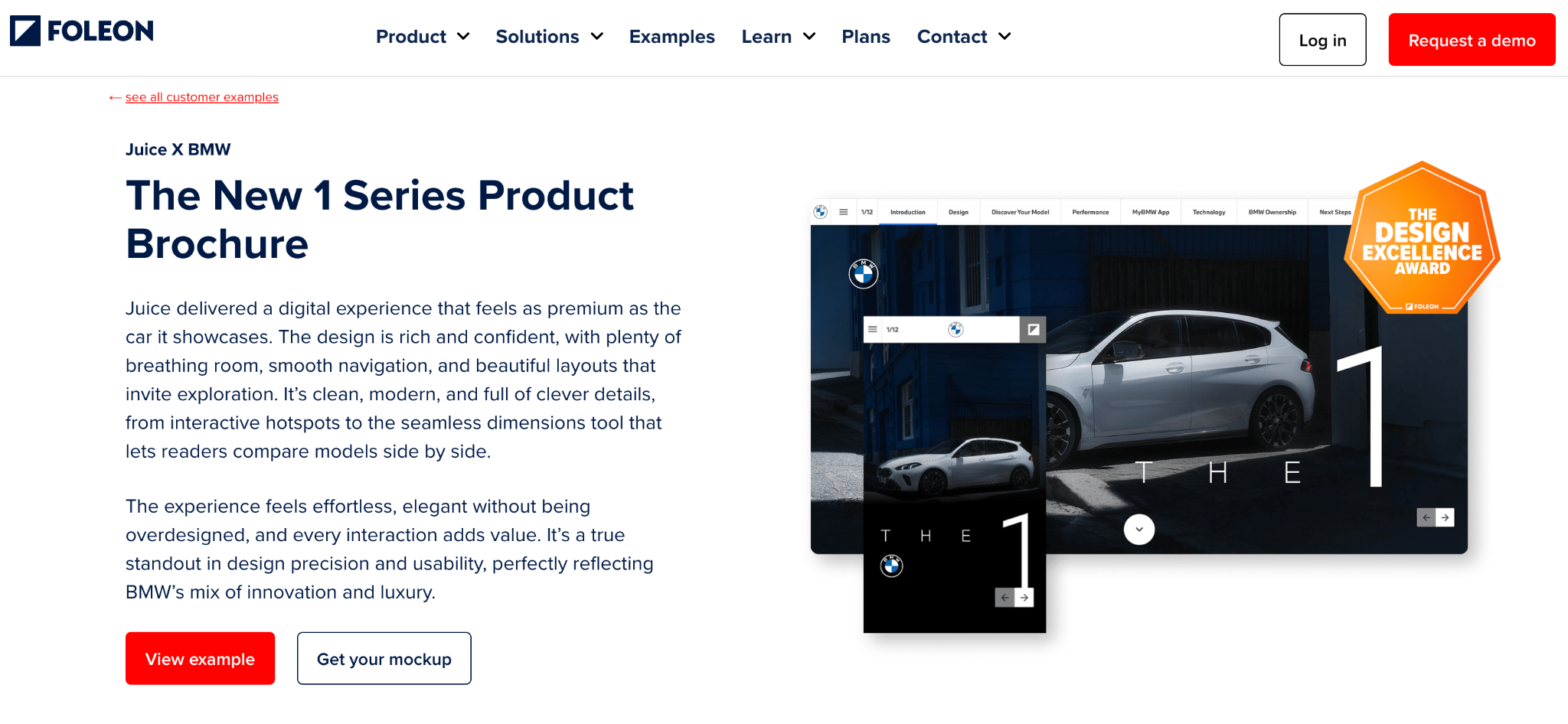
With interactive content, both buyers and sales reps can click navigation menus, open embedded videos, and flip to the sections they need.
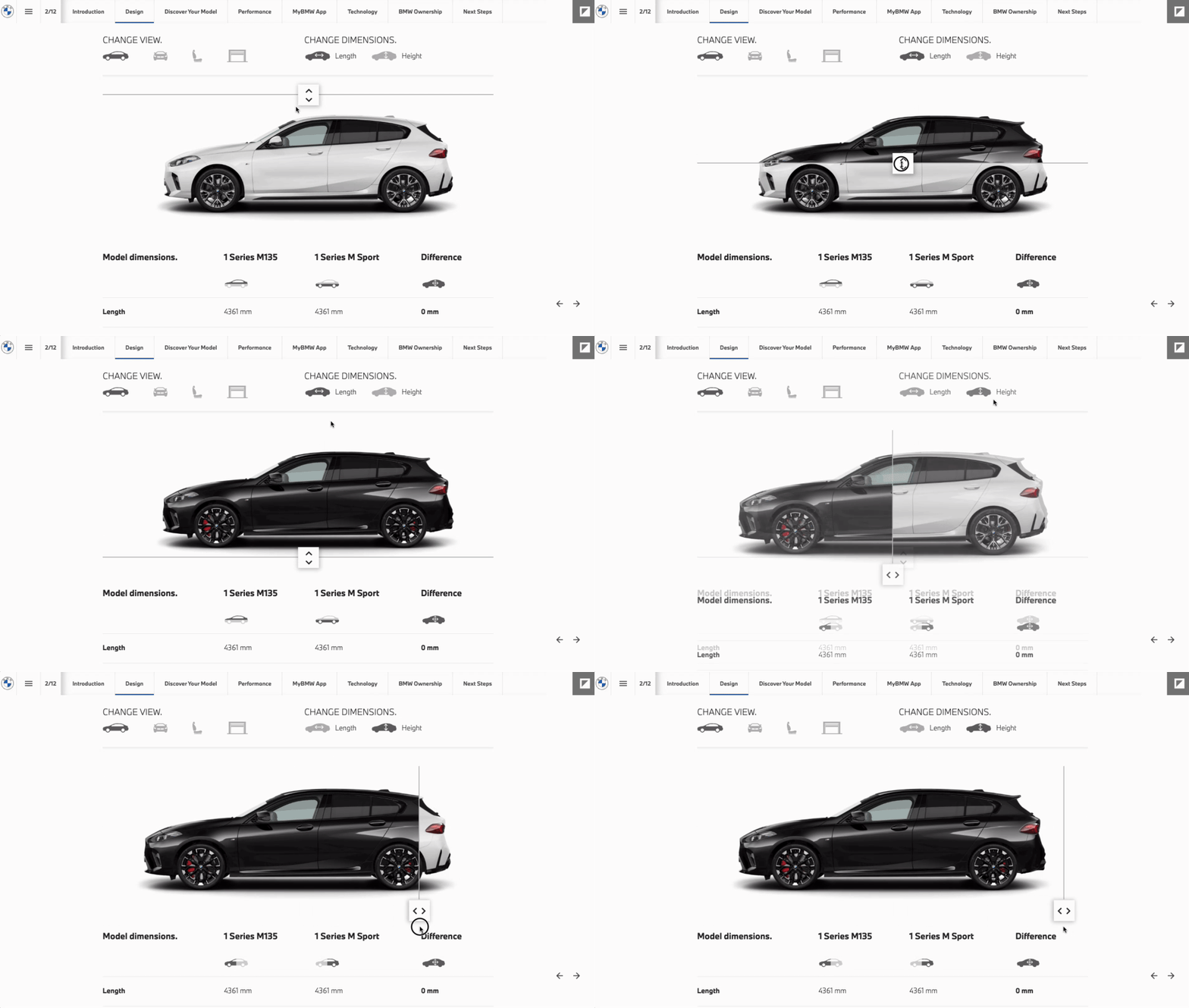
BMW Interactive Brochure Created in Foleon
Personalized over generic
One-size-fits-all content doesn’t work anymore.
A finance leader might focus on ROI. An operations team may care more about implementation. A department head may simply want to know what makes life easier for their team.
That’s why you need to personalize your content to the person you’re talking to and the questions they have.
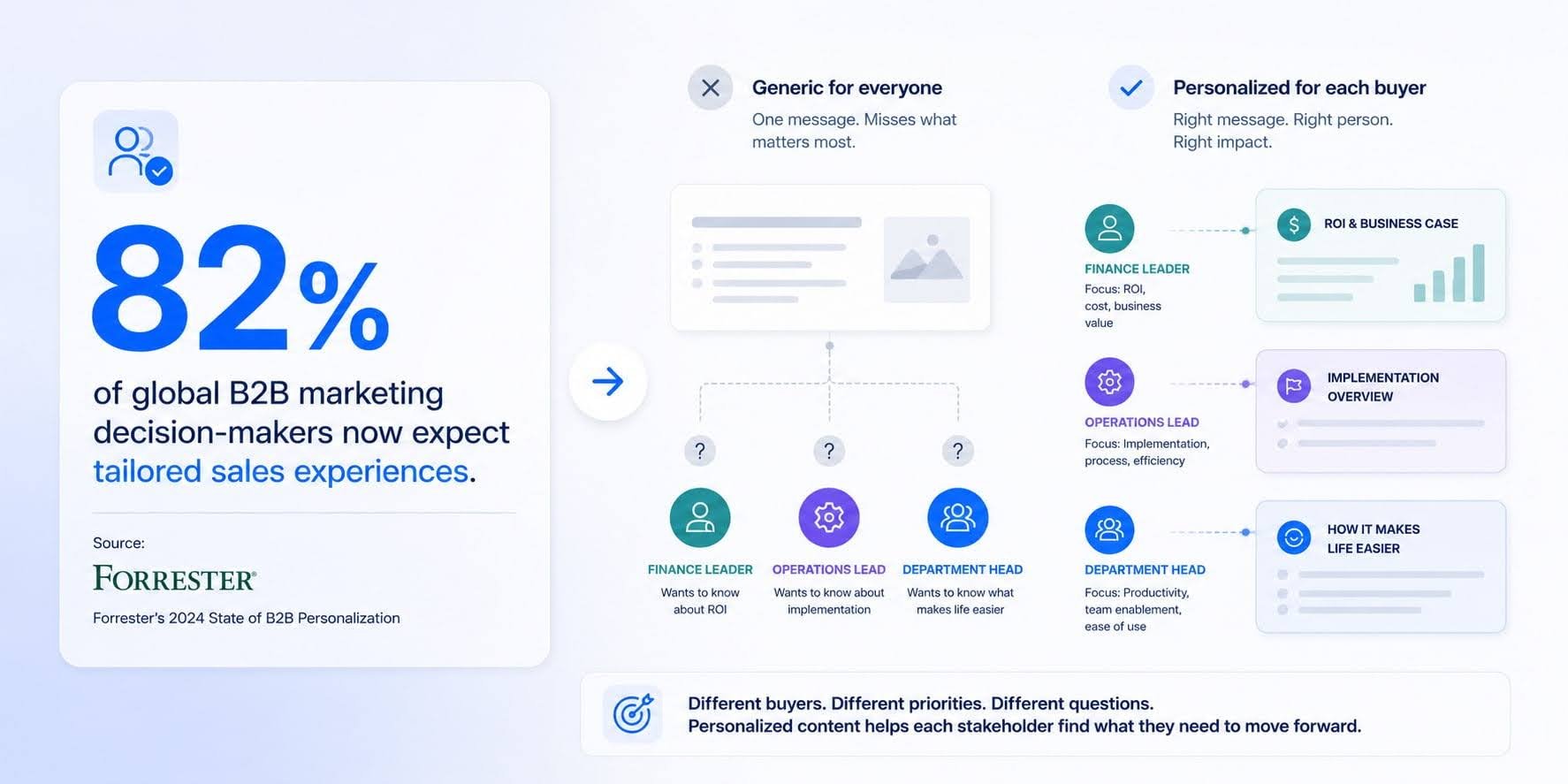
Why personalized content wins in B2B sales
As Forrester’s 2024 State of B2B Personalization found, 82% of global B2B marketing decision-makers now expect tailored sales experiences. So, the days of sending everyone the same deck and hoping for the best are fading fast.
Sales-enabled over marketing-led
Content should support real sales conversations. (This is called sales-enablement content.) Reps need sales-enablement assets that answer key prospect questions and address objections before they come up
Let’s explore this more below.
1. Content that helps start better conversations
Most buyers aren’t looking for a sales pitch during the first conversation. They’re trying to understand whether a problem is worth solving and whether your solution is worth exploring.
Sales teams are looking for a way to explain complex ideas without overwhelming people.
Some of the most useful formats to help with this include:
- Interactive landing pages
- One-page overviews
- Visual summaries
- Short pitch decks
When those assets are done well, conversations become less about explaining what a product does and more about whether it’s the right fit.
2. Content that handles objections before they come up
Every buyer has concerns.
They want to know whether the investment is worth it, how difficult implementation will be, what results they can expect, and what could go wrong along the way.
Sales teams need clear answers to these common objections before they come up.
Content that works well here includes:
- Comparison pages
- ROI breakdowns
- Customer stories
- Case studies
3. Content that adapts to different buyers
Getting one person excited about a purchase is hard enough. Getting 13 people to agree is another story entirely.
Yet according to Forrester, that’s exactly what you need to do. As Forrester’s 2024 State of Business Buying Report shows, an average of 13 people are involved in the buying decision.
And they all have different priorities and questions. (You have decision-makers and users, as well as technical and non-technical stakeholders.)
That’s why the best sales enablement content bends a little.
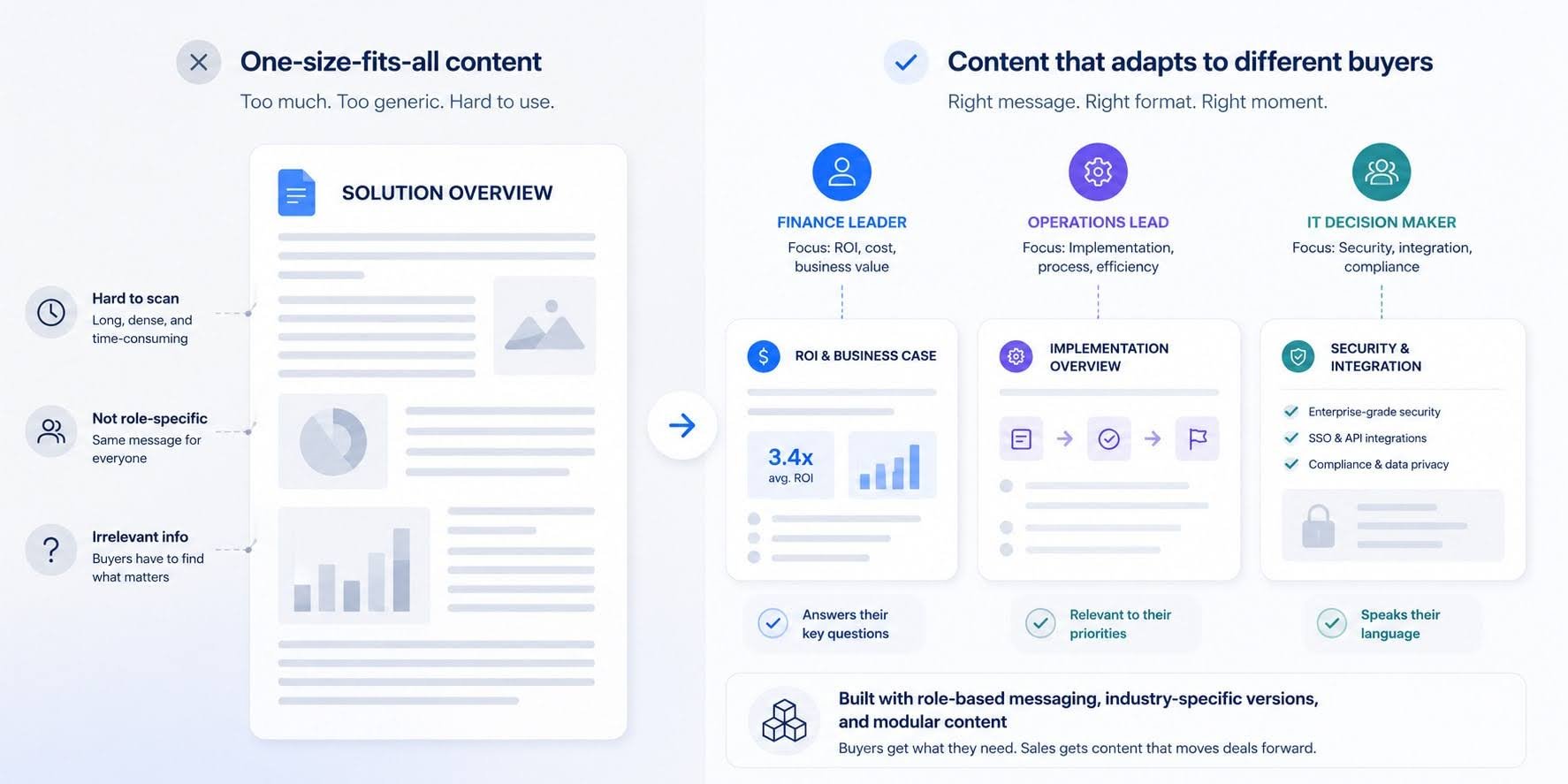
Personalizing content for different buyers
To make content more adaptable, experiment with:
- Industry-specific versions
- Modular content blocks
- Role-based messaging
*Pro tip: Train your sales reps on how to use adaptable content before they interact with leads. (So they don’t get lost when speaking to a prospect.)
Speaking of which...
4. Content that’s easy to share and use in real time
A sales call isn’t the moment anyone wants to start searching through folders.
If a rep needs a case study, pricing guide, or product overview, they should be able to find it quickly and jump straight to the section that matters to the buyer they’re speaking with.
The best sales content is also built for real-world use.
Great examples include:
- Mobile-friendly content
- Interactive documents
- Personalized links
The easier the content is to find, share, and adapt, the more likely it is to become part of the sales conversation.
5. Content that shows clear value
Nobody wakes up hoping to read another product brochure.
They’re trying to solve a problem quickly, without the marketing fluff.
Buyers aren’t looking for a list of features. They’re trying to figure out what changes if they choose your solution.
They want:
- Before-and-after examples
- Visual data summaries
- Customer stories
- Testimonials
The most useful content gives buyers something concrete to hold onto. A result. An outcome. Proof that other people have solved a similar problem before.
6. Content that supports the entire sales journey
A buyer who’s just discovered a problem doesn’t need the same content as a buyer comparing vendors.
Different stages call for different resources.
Use educational content and industry insights early on, then bring in comparisons, pricing information, ROI data, and customer proof later.
The trouble is that most content libraries just happen, without much planning.
Someone publishes a blog post. Someone requests a one-pager. Sales needs a case study. Before long, you’ve got hundreds of assets and no idea what’s missing.
Applying strategic portfolio management principles can help bring some order to the chaos:
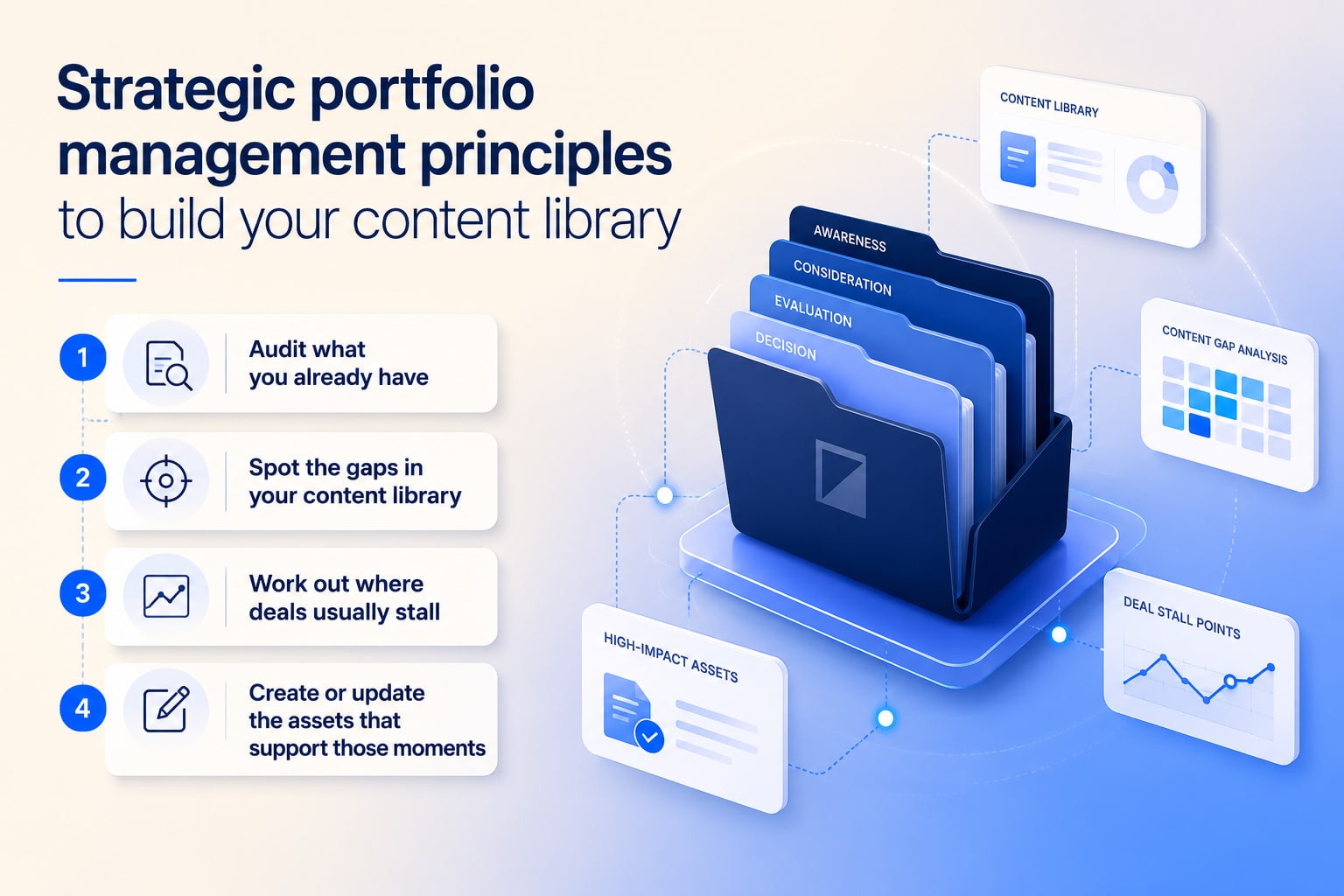
(Image by Ioana)
Strategic Content Portfolio Framework
To use these principles...
- Audit what you already have.
- Spot the gaps in your content library.
- Work out where deals usually stall.
- Create or update the assets that support those moments.
7. Content that provides feedback and insights
This is one of the most underrated benefits of digital content.
Imagine finishing a sales call and knowing exactly what the buyer looked at afterward.
- Did they ignore half the document and keep returning to the ROI page?
- Spend more than ten minutes on the pricing section?
- Share the case study internally?
That’s useful data to know.
Those little signals tell you what’s resonating, what’s causing hesitation, and where the next conversation should go.
Instead of guessing what to discuss next, teams can use engagement data to make follow-up conversations more relevant.
How marketing teams can start creating sales-ready content
Now that it’s clear what kind of content sales teams need, here’s how your marketing team can create better sales-enablement content:
- Start by talking to sales regularly. Review objections, stalled deals, and recurring buyer questions. (Ask for real sales call recordings.)
- Audit your content library. Identify what’s helping sales, what’s gathering dust and needs updating, and what’s missing.
- Prioritize usefulness over volume. Select your most valuable assets and park them in an asset library that reps can easily access.
- Test and improve continuously. Learn from conversations, update content regularly, and pay attention to engagement data.
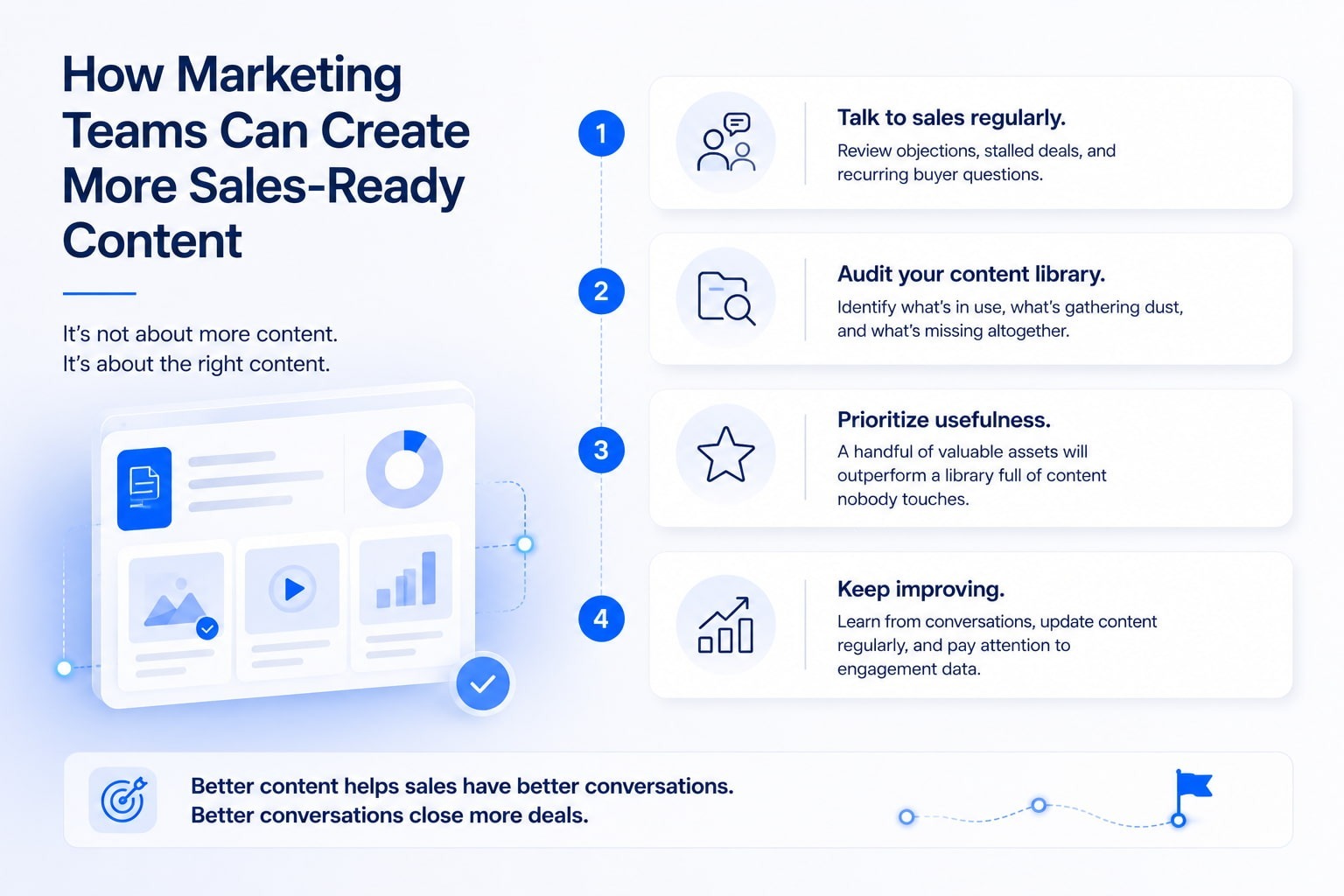
(Image by Ioana)
Four Steps to Create Sales-Ready Content
Common mistakes to avoid
To recap, here are some common mistakes that might be sneaking into your sales content strategy.
- Creating content without sales input. The people speaking to buyers every day usually know what the real questions are. Use them to guide your content.
- Overloading assets with information. More pages don’t automatically make content more useful. Trim the marketing fluff and focus on helping buyers make a decision.
- Ignoring buyer objections. If the same concerns come up in every sales call, your content should be helping answer them. Save sales time and tackle them up front.
- Making content difficult to customize. One-size-fits-all rarely fits anyone particularly well. Build content that can flex to different buyers and situations.
- Focusing only on top-of-funnel content. Buyers need support throughout the decision-making process. Make sure to have content that targets prospects in the awareness, consideration, and purchase stages.
- Relying on static, untrackable formats. If you cannot see whether buyers opened, read, or shared an asset, it is harder to know what helped move the deal forward.
What sales-ready content looks like in 2026
By now, the pattern is pretty clear.
Sales-ready content is:
- Interactive. Buyers can explore the information that’s most relevant to them.
- Personalized. Different stakeholders can find answers to their specific questions.
- Easy to adapt. Sales teams can tailor content without having to create everything from scratch.
- Built around buyer questions. It helps people solve problems and make decisions.
- Measurable. Teams can see what’s being viewed, shared, and revisited.
- Connected to real conversations. It reflects the questions, concerns, and objections buyers actually have.
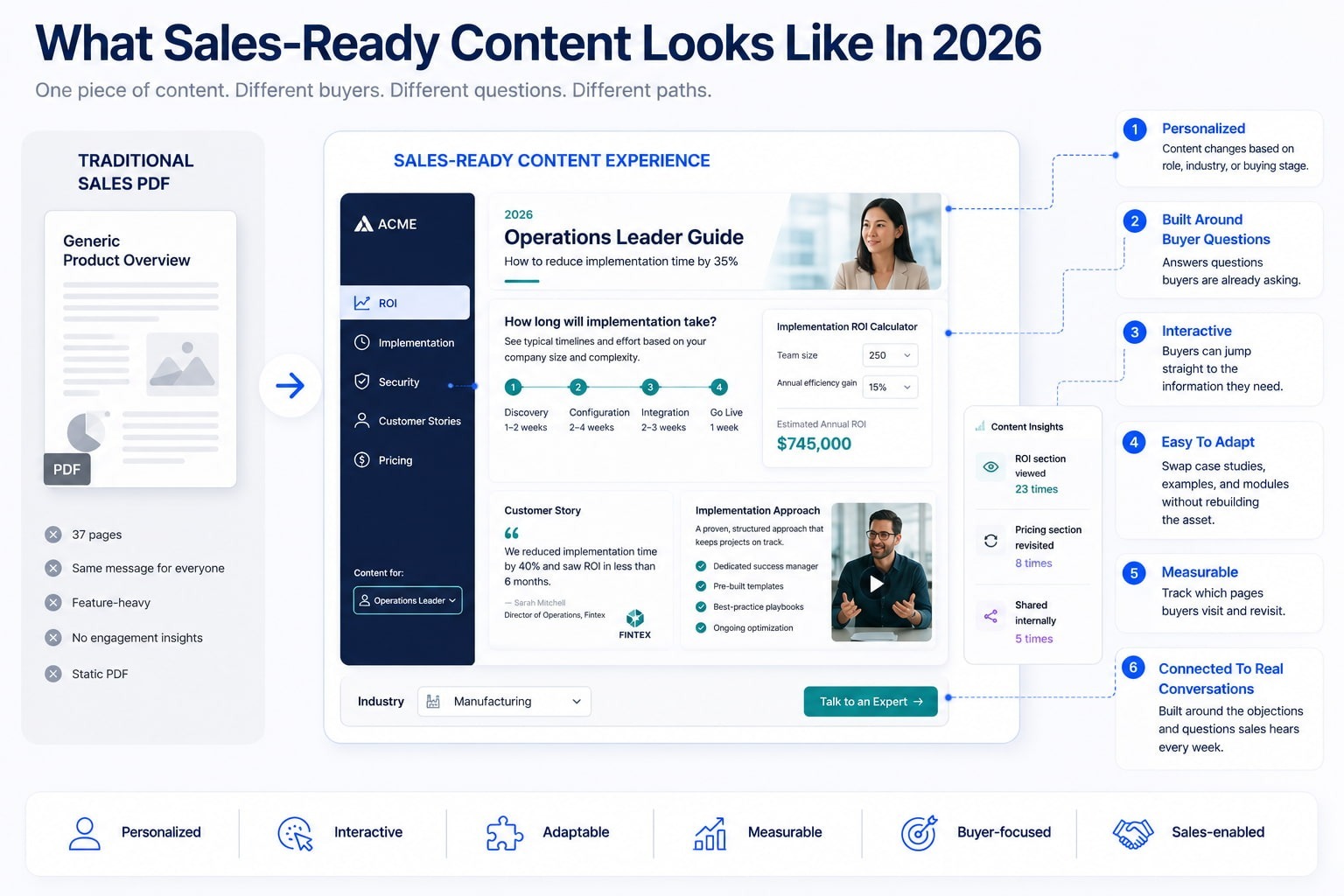
(Image by Ioana)
What Sales-Ready Content Looks Like In 2026
Align content with conversations
Most buyers aren’t looking for another boring brochure.
They’re looking for answers. When teams understand how to use content for sales, those assets become more than handouts. They become part of the conversation.
Sales and marketing teams that make those answers simple to find, explore, and share have a much easier time turning interest into action.
Meet Foleon
Unlike PDFs, Foleon Docs unlock insights about your audience, individual contacts, and content performance.

Ioana is a business strategist and content writer for B2B tech and SaaS brands. She also helps aspiring entrepreneurs build remote businesses. Born in Transylvania and raised in Texas, Ioana has been living the digital nomad life since 2016. When she’s not writing, you can catch her snorkeling, exploring, or enjoying a café con leche in Barcelona!
Want to write for the Foleon blog? Here's how to submit a guest post.