![foleon_logo_white.png]](https://www.foleon.com/hs-fs/hubfs/foleon_logo_white.png?height=40&name=foleon_logo_white.png)
In this article:
⚠️ Conversational AI is currently in Closed Beta. If you're interested in joining, reach out to your Customer Success Manager.
What is Conversational AI?
Conversational AI turns your Foleon Doc into an interactive chat experience. Instead of scrolling through a long document, readers can ask a question and get an answer pulled directly from that Doc's own content, along with a link back to where the information lives. Conversational AI only answers based on the content of the Doc it's set up for. It never pulls in outside information.
Setting up Conversational AI
Setting up Conversational AI takes three steps: create it, configure how it responds, and turn it on for your Doc.
Step 1: Enable AI availability
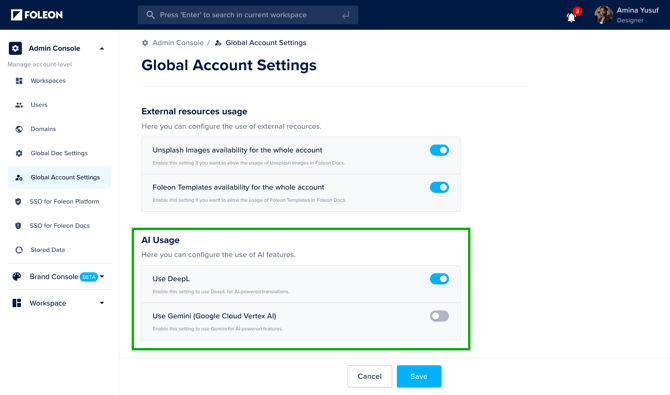
To use Conversational AI, the AI setting allowing the use of Gemini must be enabled for your account. This controls access to several AI-powered tools such as image generation, PDF conversion, and writing assistance.
⚠️ Access to the AI-powered features using Gemini is turned off by default. Only Admins can enable this option in the Admin Console.
To enable the use of Gemini:
- Go to the Admin Console in the dashboard
- Navigate to Global Account Settings
- Toggle on the setting for Use Gemini and click Save
📖 For more information, read our article: Active AI for your Account
Step 2: Create your Conversational AI Agent
Every Conversational AI is created for one specific Doc. Start by naming it and choosing which Doc it should pull answers from.
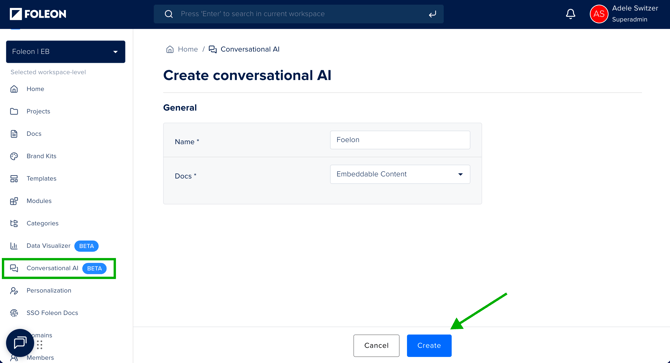
- On the Dashboard, under your workspace, go to Conversational AI in the menu.
- Click Create Conversational AI.
- Enter a name.
💡 The name you enter here is visible to readers. It appears in the chat as Ask [Name]. For example, naming it Foleon will show as Ask Foleon in the chat. Choose a name your readers will recognize. - Select the Doc you want to create it for.
- Click Create.
💡 You can set up one Conversational AI per Doc.
Step 3: Configure how it responds
Once your Conversational AI is created, you can specify exactly how it talks to readers and what it does when it doesn't have an answer. All of this is set from the Edit screen.
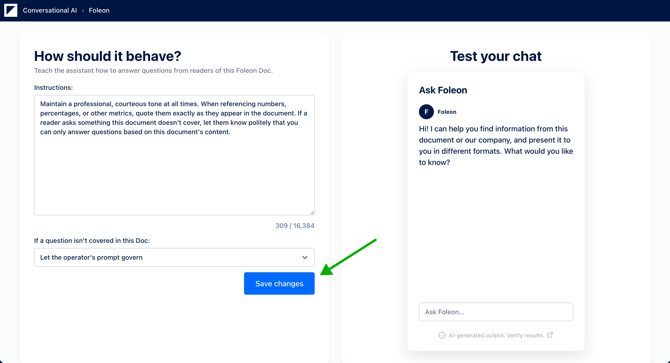
- On your Dashboard, hover over your Conversational AI in the quick actions menu and select Edit.
- Under Instructions, describe how it should behave, including tone of voice and any other guidance you want it to follow.
- Choose how it should respond to questions your Doc doesn't cover:
- select Refuse with a fixed reply to use the default response, "I can only help with topics covered in this document", or
- select Let the operator's prompt govern to have your instructions above decide the response instead.
- Click Save.
Example instructions
Maintain a professional, courteous tone at all times. When referencing numbers, percentages, or other metrics, quote them exactly as they appear in the document. If a reader asks something this document doesn't cover, let them know politely that you can only answer questions based on this document's content.
💡 Be specific in your instructions. Clear guidance on tone and scope leads to more consistent answers.
Step 4: Turn on Conversational AI for your Doc
Creating and configuring your Conversational AI doesn't make it live. You still need to switch it on in your Doc's settings and publish before readers can see it.
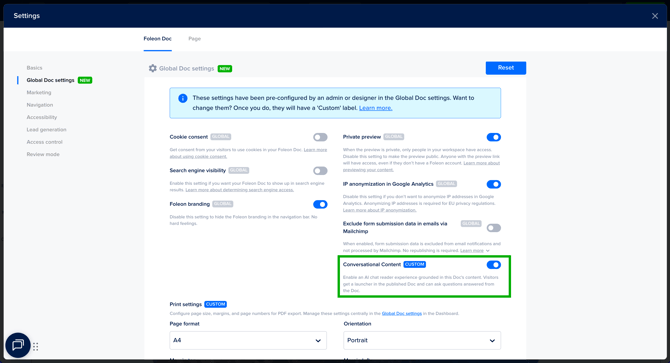
- Open your Doc Settings either from the menu in the Editor or the quick actions menu (⋮) on your Doc in the Dashboard.
- Turn on Conversational content.
- Click Save.
- Publish or republish your Doc.
✅ Once Conversational AI is turned on and your Doc is published, readers will see the chat as soon as they open the Doc.
Turn it on by default for all Docs (Admins)
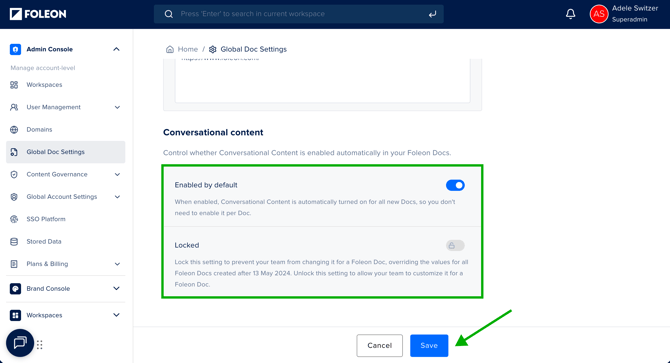
This setting applies across your entire account, rather than one Doc at a time. Turning it on means every new Doc automatically has Conversational content enabled, so you don't need to switch it on individually.
- Open Admin Console > Global Doc Settings.
- Go to the Conversational content section.
- Turn on the toggle labeled Enabled by default.
- Click Save.
You can also lock this setting so individual Docs can't override it. Once locked, all you need to do after creating a Conversational AI for a Doc is publish.
See what readers experience
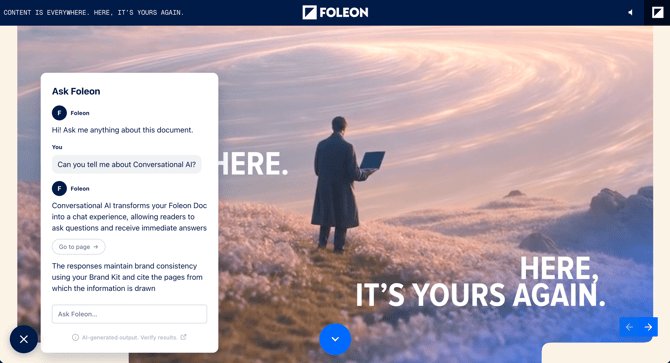
On a published Doc, readers see a chat option. They can ask a question about anything in the Doc and get an answer right away, pulled from the Doc's own content. Each answer shows where that information came from and includes a link to the exact page. Readers can click that link to jump straight to the source content.
If a reader asks something the Doc doesn't cover, they'll get the response you set up in the Instructions step.
💡 Each reader is limited to 20 messages per hour. Answers are text-based with a link back to the Doc. Conversational AI doesn't generate images, charts, or take actions like submitting a form on a reader's behalf.
View your analytics
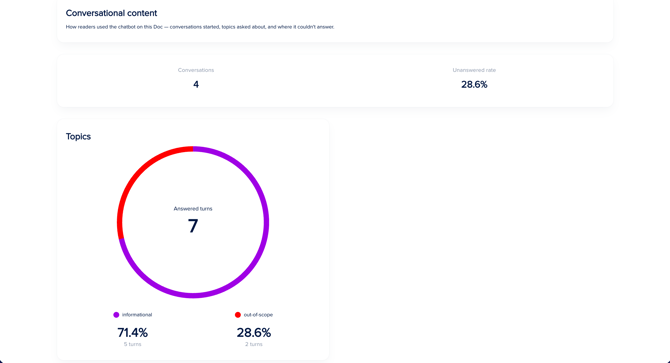
Once your Conversational AI has been live for a while, you can check how it's performing directly from your Dashboard. This shows you how many readers are using it and how well it's answering their questions.
- On your Dashboard, locate your Doc.
- Click the quick actions menu.
- Select Foleon Analytics.
- Scroll to the Conversational content section.
Here you'll find:
- The number of conversations started
- The unanswered rate (how often Conversational AI wasn't able to answer a question)
- The total number of answered turns, broken down by percentage of informational answers (what it could answer) and out-of-scope answers (what it couldn't)
FAQs
Does Conversational AI use information from outside the Doc?
No. It only answers using the content of the Doc it's created for.
What happens if a reader asks something the Doc doesn't cover?
It depends on your response setting. You'll either get the default response, "I can only help with topics covered in this document," or a response guided by your own instructions if you selected Let the operator's prompt govern.
Is there a limit to how many messages a reader can send?
Yes. Each reader can send up to 20 messages per hour.
Can I turn off Conversational content for one Doc if it's enabled by default for my account?
Yes, unless your admin has locked the setting at the account level.
What personal data does Conversational AI collect?
End-user chat messages, conversation history, and hashed visitor identifiers. Operator-authored system prompts are stored on the chatbot record. PII redaction is enabled by default. Customers are advised not to use the chatbot for regulated workflows (healthcare, financial eligibility, etc.) during V1.
Legal disclaimer
When you enable Conversational AI on a Doc, readers' questions and technical data (IP, device) are processed by our contracted AI sub-processors to generate answers and run the service; they aren't used to train AI models, and transfers outside the EEA rely on valid safeguards under your DPA with us. The AI answers only from the content of the Doc it's embedded in and makes no automated decisions about readers, and we show readers an in-chat notice that they're interacting with AI.
As the publisher, you're the controller for your readers' data, so you're responsible for: not placing sensitive or third-party-protected content in the source Doc unless you have the rights or a lawful basis; obtaining cookie consent on your published Doc where required; and handling reader data-rights requests. See our Privacy Policy.